AI Helps Us Find Hidden Meaning in the Art of the Late, Great Khun Pichai [S8.E61]
![AI Helps Us Find Hidden Meaning in the Art of the Late, Great Khun Pichai [S8.E61]](https://img.podpage.com/MkysZe31p5o9_mAmBDIyCPnO0A4smeNK_TCz6dd-P9E/rs:fit:480:0:1/q:75/aHR0cHM6Ly9tZXRhaW1nLnBvZHBhZ2UuY29tLzdJN2Q3TTVWNGRIY3BQRUZFRmVQQnlXUG03MC10LXp0eXRSaWRWaHZxdVEvZXlKb0lqbzJNekFzSW0waU9pSmliSFZ5SWl3aWRTSTZJbWgwZEhCek9pOHZjM1JoZEdsakxteHBZbk41Ymk1amIyMHZjQzloYzNObGRITXZaQzg1TDJZdllTOWtPV1poTkRBek5EWXlOMlEzTW1FMFpUVTFaVE5qTVRBd1pHTmxOell3TlM5Q1MxQTRYMFZRWDB4UFIwOWZOakV1YW5Cbklpd2lkVElpT2lKb2RIUndjem92TDNOMFlYUnBZeTVzYVdKemVXNHVZMjl0TDNBdllYTnpaWFJ6THpjdllpOW1MelV2TjJKbU5UVTBPR05pTWpsa01ETTRabVE1TlRsaFptRXlZVEZpWmpGak9EY3ZVemhmVTJodmQxOU1iMmR2TG1wd1p5SXNJbmNpT2pFeU1EQjkud2VicA.webp "AI Helps Us Find Hidden Meaning in the Art of the Late, Great Khun Pichai [S8.E61]")

 RSS Feed
 Spotify
 Apple Podcasts
 Greg begins by discussing the late Bangkok street artist Khun Pichai, whose intricate and cryptic sidewalk scribbles across the capital attained a devoted cult following over the years, with sightings of his mysterious, sprawling artworks treated like discovered treasures. If you don’t know who Khun Pichai was, watch this excellent short documentary to get an idea.
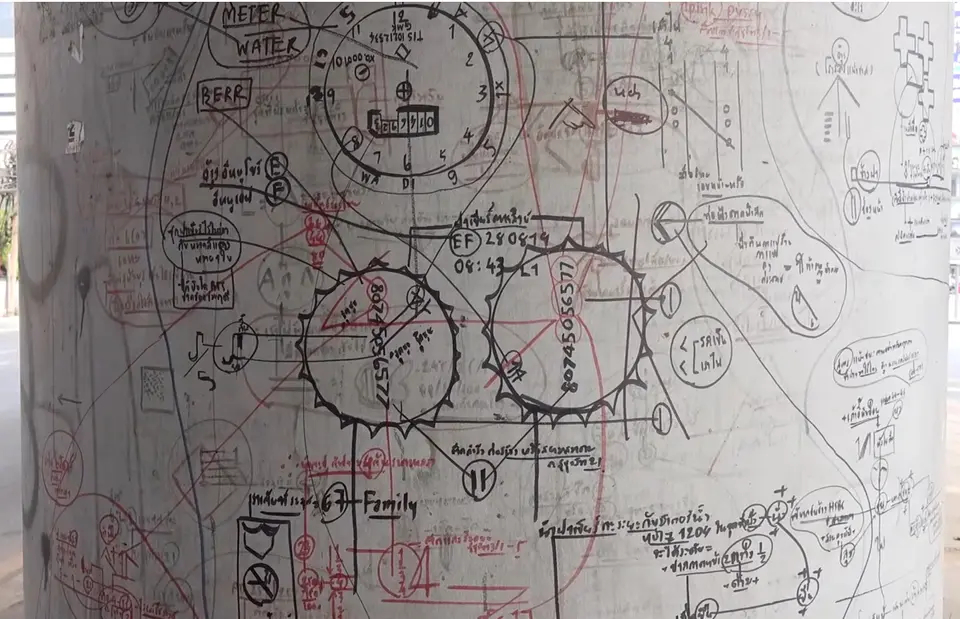
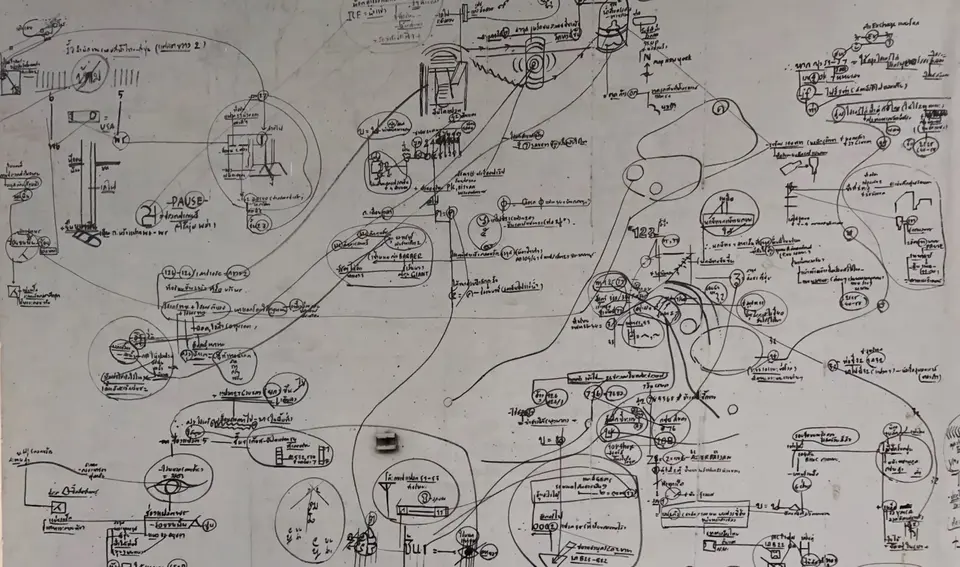
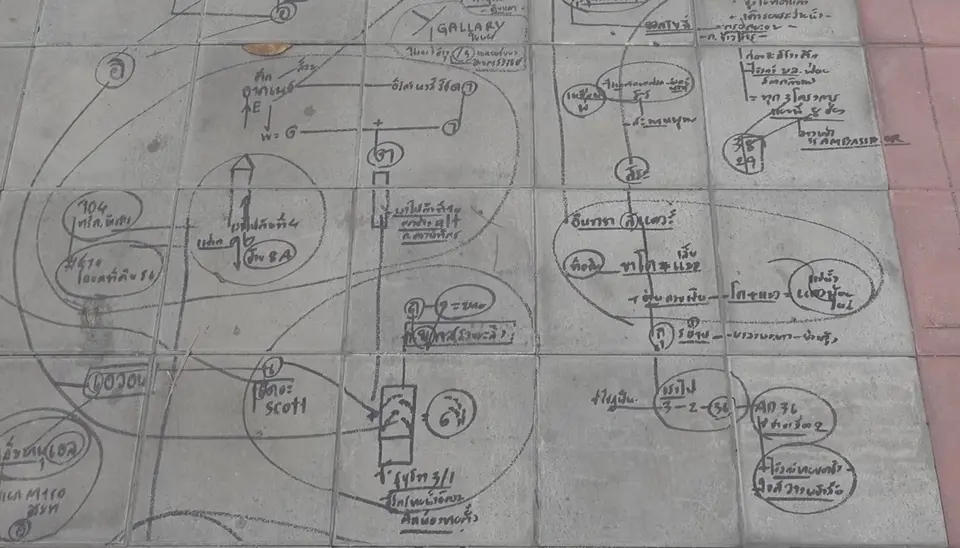
Many people dismissed Khun Pichai’s art as “crazy” or “nonsense” but we think there was something else there. So, we harnessed the power of AI to give us some insight, and perhaps find details that we simply were not able to see. Ed reflects on the artist's complex background, observing that Khun Pichai seemed to possess a rich internal life that found raw expression through public city surfaces. Check out the images we used below to see what we're talking about!
Next, Greg walks through the artificial intelligence interpretations of several individual pieces - find them on our website if you’d like to follow along. The software explains that the seemingly chaotic drawings actually repurpose utility meter readouts, bureaucratic paperwork, radio schematics, and Thai consonants treated like algebraic variables. Ed points out that Khun Pichai famously considered his sketches to be investigative notes and evidence rather than conventional art, demonstrating an intensely focused technical mindset.
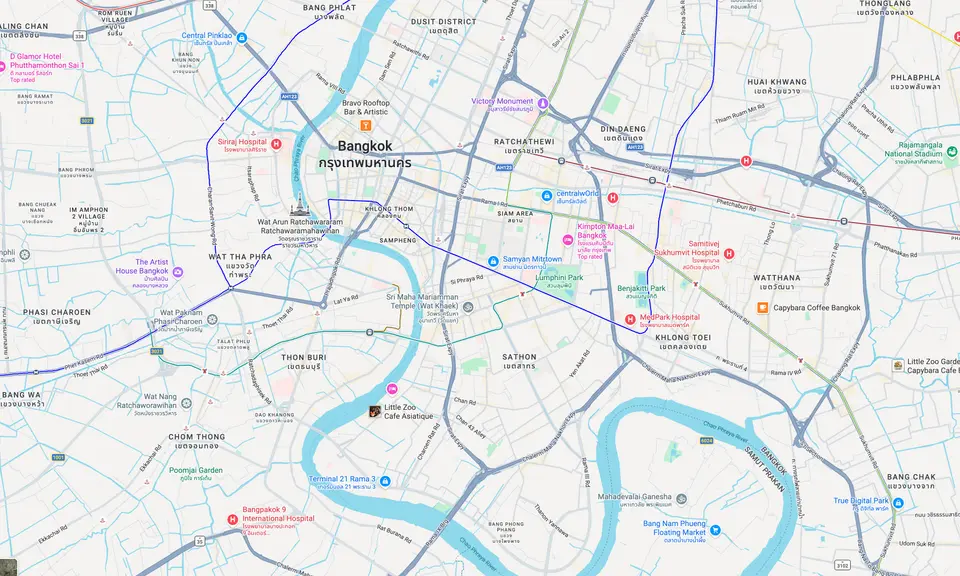
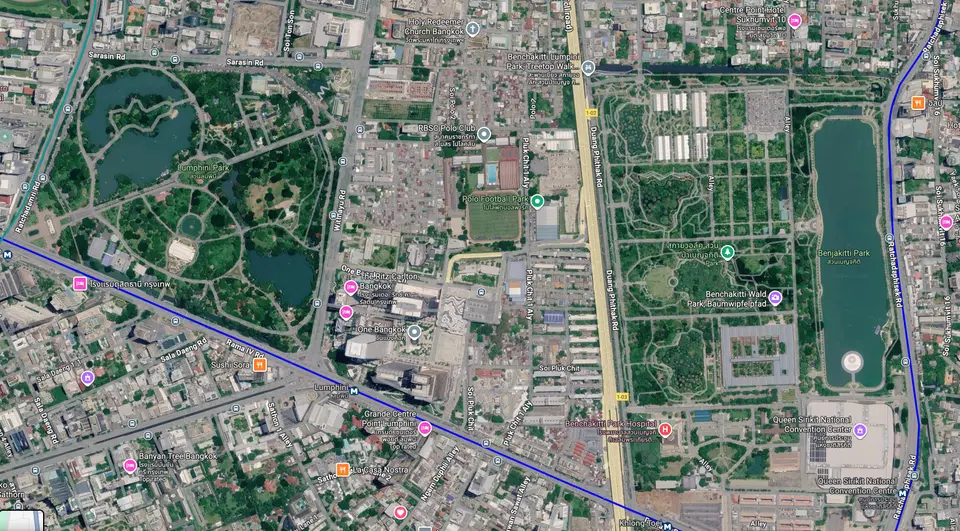
Moving forward, Greg shifts the focus to other Bangkok subjects evaluated by artificial intelligence. Greg explains how the software analyzed a city map, attributing notorious traffic congestion to modern roadways that haphazardly traced ancient canals rather than planned survey grids (no surprise, but still pretty on the money). Ed and Greg then explore the program’s evaluation of longtail boat mechanics, highlighting why repurposed car engines and long propeller shafts remain ideal for narrow waterways. Greg concludes the exercise by sharing an artificial intelligence comparison of Lumphini and Benjakitti parks, contrasting early European landscape ideals with contemporary ecological design.
While using the cold, inhuman logic of an AI to analyze the warm, squishy creativity that flowed from a human mind might seem a bit gauche, AI is nonetheless a powerful tool that can uncover hidden details.
Greg 00:00:03 On this episode, we marshal the analytical skills of AI to help us decipher the art of the late, great gourmet kitchen.
Ed 00:00:10 So if you've ever wondered what those legendary Bangkok sidewalk scribbles were trying to say, you'll love this episode of the Bangkok Podcast.
Greg 00:00:27 Sawatdee krap! And welcome to the Bangkok Podcast. My name is Greg Jorgensen, a Canadian who came to Bangkok in 2001 after tragically learning that I was not, in fact, selected as a finalist for the 2001 Mr. Lumberjack calendar.
Ed 00:00:43 I would put you on my Mr. Lumberjack calendar.
Greg 00:00:46 Thanks, man. Means a lot. Let me ask you a question.
Ed 00:00:51 And I met Knuth, an American who came to Thailand on a one year teaching contract over 26 years ago, fell in love with trying to convince every tourist to only go by the meter and taxis until they realize how little the taxi drivers are actually asking for. So I never left. It's really annoying, you know? I've got a buddy in town and you know, this has happened to me many times where I'm trying to explain to him, like, only go by the meter.
Ed 00:01:16 And then when I tell him that when he finds out that the taxi driver wants 300 baht, which is like $10, he's like, oh, oh, it's just $10.
Greg 00:01:26 Yeah.
Ed 00:01:26 So that's. So then. So then they're like.
Greg 00:01:28 A principle.
Ed 00:01:29 You know? Yeah, exactly. You know, they always say something like, do you realize how expensive it is to get from JFK, you know, to, you know, wherever they want to go? And it's like it's $85, but I'm like, This is Bangkok. Like, please go by the meter. You're destroying the market.
Greg 00:01:45 You're making it worse for me.
Ed 00:01:46 That's right. All right. We want to give you a big thanks to all of our patrons who support the show. Patrons get every episode a day early, behind the scenes photos of our interviews, a heads up to send questions to upcoming guests and access to our discord server to chat with me, Greg and other listeners around the world. But best of all, patrons also get an unscripted, uncensored bonus episode every week where we riff on current events and Bangkok topics on this week's bonus show.
Ed 00:02:14 We chatted about the dilemma of paying for an expensive meal in Bangkok, when a great meal on the street outside can be had for a fraction of the price. A chat about a few of our favorite classic movies set during the Vietnam War, and discussions on writing quality AI prompts, and what happens when the software's programmed biases prevent you from doing what you asked it to do. To learn how to become a patron and get all this good stuff. Plus, full access to over 800 bonus and regular pack episodes. Click the support button at the top of our website.
Greg 00:02:50 Right, and a quick update before we dive into the main show now and check this out. I'm not sure if you remember, but back in I guess it was season seven, episode 59. We did a Bangkok history highlight on a guy named George DuPont, and he was the only Thai person to fight in the American Civil War. quite a story that he had. And, he's actually buried at the Protestant Cemetery on Charing Cross Road.
Ed 00:03:18 I do remember this. So now I do remember this, show we did. Yes.
Greg 00:03:22 Yeah. So we got an email out of the blue the other day from a listener in new Jersey. And check this out. This is. Hello, Greg. And my name is Michael, and I'm a social studies teacher from new Jersey. The reason why I'm writing to you today is because I saw your podcast on George DuPont, the only known American Civil War veteran buried in Thailand at Bangkok's Protestant cemetery. I wanted to let you know that in conjunction with the Sons of Union, Civil War Veterans and the Women's Relief Corps, we obtained a new VA approved headstone for George DuPont. The headstone was installed on July 16th and on July 19th. Flowers were placed on the grave in commemoration of the 126th anniversary of DuPont's death. Isn't that cool?
Ed 00:04:01 That's super cool. Wait, wait, you mean a new headstone here in Bangkok?
Greg 00:04:05 That's right. At the Protestant cemetery. I'm going to go on this weekend and check it out.
Ed 00:04:08 Dude, you got to take a picture. That's awesome.
Greg 00:04:10 Yeah, yeah, it's pretty cool. Great story. If you love history. This guy had a hell of a life. but, it was great to to get a message like that. That's really super cool.
Ed 00:04:20 Oh, great.
Greg 00:04:22 Yeah. Thanks for writing in. Michael. And I will send you photos as well when I get out there. All right. Well, in this episode, we take inspiration from someone whose name you may not recognize, but whose art you most likely have seen. We are talking about Kun Pichai Ratana pon Chai, and he was the man behind the cryptic, mysterious, strangely beautiful scribblings in ink that have been seen around Bangkok for the past 10 or 12 years. Highly intricate, totally hard to decipher, but beautiful in their own right. The drawings took on a bit of a cult status in recent years. Sadly, we learned this week that Kuniyoshi has passed away and his art will be missed by many.
Greg 00:05:01 However, our friend Andrew did something this morning when we were talking about this that I thought was borderline genius. He asked AI what it could make of one of Kun Peach's drawings, and got a surprisingly dense answer that provided way more insight than we could have gotten on our own. So we thought, in honor of the man's work, we take that concept and run with it a little bit, not only on a few of his drawings, but on a few other Bangkok items as well. Now, we know not everyone is a fan of AI, but in the right conditions it can be a powerful learning tool. So let's see what we can get up to. And I have to say, right off the bat, there's probably going to be a lot of reading here. We asked AI to analyze some stuff for us and got the results. We trimmed them down quite a little bit, but still we're going to go through the answers, and you can follow along with the photos on the website that we will put for people to look at while we read.
Greg 00:05:55 So. Ed, you're an AI guy like I am. What do you think?
Ed 00:05:59 I like this concept. there's a lot of things in Bangkok that, we take for granted, or because we're in. Because we're in the bubble. Because we're inside of it. We don't think about what it might mean or harm. Might look to, fresh eyes, you know? So, for example, like the map of Bangkok and seeing the way the child river twists and turns, you know, you and I were used to it. but it's actually kind of weird. You know, it's like, it's just. It's just a weird. It's a weird place to put a city. And so, you know, asking the AI just, hey, what do you like? What do you think about this map? Like, what's your what's your first take or your fresh impression? I think it's an interesting thing. And of course, those drawings, that street art. I remember saying that very early. Like, I mean, you know, I've been here since 2000.
Ed 00:06:56 I don't know for sure that I saw it like in 2000, but it's been a part of Bangkok for a long time.
Greg 00:07:03 Yes. And I, I also probably I remember 15 years ago I saw something like that and I think it was probably couldn't be Thai and, I've seen it over the years at various places around, around the city. I never actually saw Koon Pichai himself, but, his stuff was instantly recognizable. That's right. And there's actually, we have to mention, there's a very good documentary by someone called Raphael Tresor on, on YouTube called Mystery Mind Maps Full documentary, and it's only about 25 minutes long, but it's a really, really well made. Interview with Kun Pichai has this as as Raphael, the guy who made this tracks him down in Bangkok and sits with him and buys him dinner and talks about his life. It's a very, very cool story. And, yeah, I guess he's going to be missed because whenever I was out with anyone who knew what it was, they would stop and go, hey, hey, look, it's here, I see it.
Ed 00:07:58 Yeah, it's a little bit of an insider thing in that it's not it's obviously not something on the on the tourist trail. And, it's a complicated topic because it, it seems like he, he has mental health issues. He, he's a homeless guy. He's creating graffiti, which I, which I presume must be technically illegal. What he's doing, he's he's drawing on, you know, city, city structures. I'm not sure I'm not sure I would want just anyone just drawing stuff all over like random city structures. But his stuff is, like, so weird and so special and so esoteric and so unique. And then, like you pointed out, it's just it's just this weird part of Bangkok that if you've lived here for a long time, you recognize, okay, that must be peachy stuff. And, so it, you know, I so I kind of, I kind of like it even though I guess it's technically illegal graffiti. Right?
Greg 00:08:51 It might not be a direct parallel, but it's sort of like Banksy, you know? Like.
Greg 00:08:54 Yeah. That's right. Encourage. I wouldn't encourage a random dude to start drawing murals on walls, but if Banksy's doing it. All right, I'll give you a pass.
Ed 00:09:01 If Banksy wants to break the law, okay, he can do it. He can do it.
Greg 00:09:05 Yeah, yeah, yeah. So, Yeah. And again, we know, you know, some of our listeners have written in saying, like, you guys talk about AI too much, but like I said, it can be a very, very powerful tool and it can provide insights that just normally day to day, Greg and Ed are not capable of getting from stuff. So, let's just go through it and, see see what AI said when I asked it to analyze some of these things. So we'll do, a few of drawings, which you can see on the website, and then we'll do a couple of other little things too, just for fun. So the first one is, is something that you can see again, see on the website.
Greg 00:09:40 And I took these as screenshots from the documentary that I talked about from the Mind Maps documentary, and this one was written on a pillar. It's got three gear looking structures and a clock. It's got a lot of lines connecting them all in red and black ink. it's pretty indecipherable. Some Thai writing, some English writing, but I thought I thought the, the output from Claude was pretty interesting. And let me just read it here. It says this seems like it has classic invented private symbol systems like glyph vocabulary and invented alphabets. But no, nearly every recurring element here traces back to real, bureaucratic and fully and utility documentation a drawn water meter face with a digital readout register, a log entry that has the exact shape of a meter reading record ten digit number strings that match Thai mobile phone number formatting. Formally, what's happening here is horror evacuee the fear of empty space executed as an all over composition. Every inch is claimed. That's a legitimate art historical tradition in its own right. The casual observer sees chaos, but what's actually there is closer to a person's entire personal administrative reality bills, contacts, family dates externalized onto a public surface because the private system needed more room than a notebook gives it.
Ed 00:10:58 Wow, I like that. I like that. I actually like that analysis. So listeners out there, you could get by on this show just with us talking, but it does work better if you can actually see see the image. so I like that because now that I've heard that, I see that this like a lot of the, the imagery and the numbers are all about bureaucracy, which is my personal nemesis. So so so so if so, if, if imagine if bureaucracy drove someone crazy. Oh. And and you know and then and then they're expressing this in, like, abstract art. this could be this could be it. You know, it's just it it is like numbers and the kind of things you would use to fill in questionnaires and gears. So I, you know, when when I looked at this before, I didn't think about that, but this is, this is jam packed with bureaucratic minutia.
Greg 00:12:04 Well, that's what's really interesting about this is because a lot of people saw Kuhn pitches stuff and was just like, oh, some crazy guy is ranting about something.
Greg 00:12:12 Right, right. But but I think most people who thought about it a bit longer was like, well, he's trying to say something, and I'm quite surprised actually, now. Now what a I said might have been total horseshit. I don't know, but it's sort of managed to wrap it in a very plausible sounding analysis. Yeah. Great. If you look. You look at the drawing and you're like, yeah, yeah, I can see all that. What it's talking about.
Ed 00:12:32 Dude, this is what art people who study art do. like. I mean, I'm not, I'm not. I'm saying Claude is right for sure, but it's not that much different than what what what, you know, art critics do.
Greg 00:12:44 Yeah, I'm done with that. I'm done with that. I don't like what I say. I don't know what art is, but I know what I like. the next one is, is something that it looks sort of like. Oh, man, it's almost like a map.
Greg 00:12:56 Sort of. It's got a lot of little swirls and lines connecting bubbles and tie writing and stuff like that. I did ask it to decipher some of the tie writing, but a lot of it sort of doesn't make any sense. It's a bit of a rabbit hole that I don't think would yield many results, but this one here, Claude says this page is a genuine network topology, a directed graph structure, the same visual grammar used in flowcharts and circuit schematics. And it's a deliberate choice, not incidental. Whoever made this is used to thinking in terms of this connects to that cause rooted to effect. The vocabulary borrowed to build that graph is technical rather than mystical. Circuit style tick marks what reads as a resistor or capacitor symbol, a radio tower with concentric signal wave rings and quote if a term that belongs to programming logic, not folk symbolism, that combination suggests the maker has some real exposure to technical or engineering vocabulary, and is repurposing it as a general purpose notation for describing how some things connect to other things.
Greg 00:14:01 Where someone builds a private technical framework to account for how global forces connect.
Ed 00:14:07 Interesting. I wonder if I have watched that documentary, although it was it was many years ago, so I don't I don't remember if anything about pitches past was revealed, but.
Greg 00:14:22 Yeah, he he did say that he used to be in the Navy I think, or the military of some type. Yeah.
Ed 00:14:26 So maybe I mean, you know for example, now with all the AI stuff I'm doing. I've shown you some, node graphs that, play a role in, like local AI, like a local AI interface. And it is all about, like, patching things together and routing this operation into that operation. And, I agree. So this thing looks like someone with a technical background as opposed to it. It's not, it doesn't have like a magical, mystical vibe that some art does.
Greg 00:15:01 Right, exactly. And it was interesting that the AI picked up on the word if because, of course, you know, a lot of programs are if then.
Greg 00:15:07 Right if this sure. Then that. Sure. So his his his lines connecting everything seems to be sort of like trying to say something.
Ed 00:15:15 That's great. Agreed.
Greg 00:15:17 Yeah.
Ed 00:15:17 I mean, the you know, there's some fairly obvious things you can say about his work. One thing you can say is it's it's sophisticated and detailed, you know, like, it's not. It's not simple. So it's not this is not a I don't know I know nothing about art or art criticism. I've never taken a class in aesthetics or studied art history. so this so this is just me. So this is me way out of my lane. But but this is not minimalistic, you know what I mean? It's like it's kind of like, detailed and, and technical. It's not. It's not stripped down.
Greg 00:15:57 Right? Yeah. I'm. I'm with you as way out of my league. But again, I'm. You know, some people don't like AI in the right circumstances. I find it can be very enlightening.
Ed 00:16:06 Yeah, yeah. No, in this case, I think it's it it's it's helping me to to at least interpret his stuff.
Greg 00:16:13 Right. So the next the final, the final peachy drawing that we're going to talk about, this one, the other ones were written on walls or a pillar under a bridge, but this one was written on the sidewalk, which is hard to miss. Sometimes. It's easy to miss his stuff. But this one was right in the middle of a sidewalk, and it's got a couple of big circles surrounding of a bunch of sort of groups of letters with numbers. And the AI says the most distinctive move in this panel is treating individual Thai consonants as algebraic variables. Several circled single letters, Gorgui, dao among them, function as labeled nodes in the network the way x, y, and z would in standard algebraic notation. That's a genuine hybrid notation, borrowing the grammar of algebra and applying it to a network of named specific real entities rather than to abstract quantities. So the underlying move here is consistent.
Greg 00:17:08 Take specific real world reference places a person numeric codes, and route them through a private notation borrowed from mathematics, as if algebra were being repurposed as a way to assert relationships between things that aren't numbers at all.
Ed 00:17:23 Interesting. So Okay. Yeah. No, it is deep. You know what? I'm what I'm realizing from this. You know, I know, I know, you grabbed these, you know, these stills. I, I, I hadn't realized that that there's a lot of diversity in his work. So if you just if you just glance at his drawings, you're like, oh, you can identify that it's him, right? Yeah. But but actually the the three that you chose actually are different.
Greg 00:17:53 Totally. That's a very good insight. Yeah. You're right. There's no consistency among them. They're all totally different takes on a different topic.
Ed 00:18:00 You know. And it's a I kind of alluded to this at the beginning. It's a little bit of a sensitive thing because you know it, you know, since he's this kind of homeless person or it, you know, there's kind of a mental health angle to all of this.
Ed 00:18:17 And so part of what we're doing almost seems a little bit. We're almost kind of peering into the mind of someone with mental health issues. yeah, but but you know, which I mean, he's publicly revealing this, of course. but it kind of shows the the complexity of what's going on. You know what I mean? Like the variety of the variety of his work and the depth of what it works of his work, it kind of shows the, the, the, his internal life. So he, he, he, he appears to be someone with issues to, to say the least. And again, I don't know anything else about his background, you know, or what's going on. And if he was someone who was like suffering, if he was in pain, if he was depressed, if he was suicidal, I have no idea. but at the very least, this shows that, he has depth. He has this super complex internal life. Yes. Because. Because this has to.
Ed 00:19:22 This stuff has to come from somewhere. Like in a way. In a way, this show is a good. in a way, it's a good anti AI show. Because this this stuff is not generated by AI.
Greg 00:19:34 Like that's a very good point.
Ed 00:19:35 You know this stuff is this stuff is 100% human.
Greg 00:19:38 It's confused. It's garbled. It's messy.
Ed 00:19:41 Yeah. Yeah. This is and it's it's genuine. It's his genuine feeling and his genuine expression. and it, you know, it's really about humanity. I mean, it shows that he's not, you know, he's not dumb. You know he's not right. He's not empty.
Greg 00:19:58 I often have thought about him in the past when I see his stuff, and I. And I'm wondering what's like in my mind. I picture this sort of like this, well, of knowledge and thought and and like tumbling processes of of ideas. But they're just, there's a barrier and they can't get out. And when they do get out, they're confused and disassembled and fragmented.
Greg 00:20:21 And it's a shame. It's a shame that that it was like that.
Ed 00:20:24 Agreed. Now I'm actually looking at some commentary on him. Right now I'm looking at it on Google and they're quoting him. and he, he he actually says it's not art. These are my notes evidence. And it's interesting. So, so the your first reaction to it is that it's, it's very artistic. But what he's trying to do is he's trying to get something out. Right. And just, just he is expressing himself. But to me this is he says these are my notes, evidence. So which is fascinating of what.
Greg 00:21:03 Yeah, I know.
Ed 00:21:04 But but but in a way it's that that makes it like real art in the sense that he's not trying to create it. He it sounds like what he's saying is that he's not making something up. So if I'm, you know, if I have a, if I have a blank page and I think of myself as an artist, then I'm creating something.
Ed 00:21:25 But but he's saying I, I'm, I'm making notes.
Greg 00:21:29 Well, it's like the, the AI said, right. Like, this stuff won't fit in a notebook. He's got to have a bigger canvas and he's a homeless guy. It's not like he can go and buy one from B to S.
Ed 00:21:39 Right?
Greg 00:21:40 Right, right. The street, the street became his canvas. His environment became his canvas.
Ed 00:21:44 Yeah. Correct, correct. But it's. You know, it's funny. I never thought about this before, but I did post, years ago, I. Okay, so sometimes, during exam period. What? I'm going to the exams. You know, students are sitting outside the classroom prepping for the exam, and they'll have their own, I guess you would call it, like a revision of my notes. So they've hand written the notes from the semester, and, like Thai students, especially the girls they love using, like, multicolored pencils.
Greg 00:22:19 Yeah.
Ed 00:22:19 Yeah. Yeah. You know.
Greg 00:22:20 So the hearts over the eyes and stuff like that.
Ed 00:22:22 Well, they'll just. Well, they'll just have my lectures, like, rewritten in their own hand in multicolor. And, to me, it's it's art, you know. So I, I a couple of times I've taken pictures of there, you know, their flow chart of my lectures.
Greg 00:22:36 Oh.
Ed 00:22:36 That's funny. And, to my eye, to me, I see this as art, but obviously they're just taking notes. It's an intellectual thing. So I think this is what's going on here. Like he. So he's not like he's not engaged in his in his mind. He's not engaging in fantasy. He's not he's not doing something fictionalised. These are these these are ideas. And what he called it, he called it evidence. And so he's just trying to capture it. Yeah, but.
Greg 00:23:06 But he's not doing it for anyone. He's he's just he's doing it because he has to do it. He's gotta get it out.
Ed 00:23:10 Right.
Ed 00:23:11 But but when you look at it, you know, with fresh eyes or as an outsider. It it it is art. Yeah, yeah.
Greg 00:23:20 Well, I that's that's all we're going to do for PTI now. So I mean we could go all night on his stuff because it's really cool. But anyone who has seen his stuff knows his stuff. And we'll talk a little bit more about that at the end of the show. But before we do that, I thought it'd be fun to apply the same process to a couple of other things in Bangkok. And, I asked the AI to take the role of a, a design architect of a of a, a traffic professional and critique a map of Bangkok. So I took a screenshot of Google Earth, and put it into the, to the map. Now, actually, to be honest, it doesn't say anything particularly insightful. It's just kind of an interesting, summary that it gave. And it said, Bangkok's original transport infrastructure wasn't roads at all.
Greg 00:24:07 It was the khlong network of the Chopra River. Roads were cut later, often following old paddy field boundaries or canal alignments rather than planned survey grids, which is why they curve and meet at irregular angles instead of right angles. The dendritic networks with no lateral connectivity mean low route redundancy. That's not an aesthetic quirk. It's the structural reason why Bangkok traffic is what it is. The street pattern itself concentrates all movement onto a small number of trunk roads with no alternate capacity.
Ed 00:24:36 Interesting. You know, we have discussed this topic before, the fact that the child pri is so twisty and bendy that that, early Bangkok ended up not being planned. Now, if you if you if you section off Bangkok, you can find some grids, you know. So if you, if you, if you, if you, if you get if you get to pick the square, you can say, okay, this makes sense. You know, this is rectilinear, like in this.
Greg 00:25:05 Little.
Ed 00:25:05 Area, in this little box, everything is like right angles.
Ed 00:25:08 But then if you zoom out, you're like, oh, shit. You know, like so when you when, when you zoom out of a map of banks. Yeah. When you zoom out of Bangkok, it's it's it's totally unplanned. So I like, I like the AI's take here. I mean, you're right. It's not it's not super insightful, but it is saying that you're kind of starting with canals and you're starting with a child prior. So that becomes the, the, the root of it. And then and then roads actually come later. And so it there's no planned like the way the AI says, there's no planned survey grid. You're not starting with a blank slate and saying, hey, let's let's have all these right angles. and so it, it it it doesn't make sense. That's right.
Greg 00:25:57 I love the term dendritic networks with no lateral connectivity.
Ed 00:26:01 That is yeah, that's a good, that's very Claude, in my opinion. My my quick take on the AI A's is.
Ed 00:26:08 Claude is the most. I don't know what the right word is. Claude is the most kind of nerdy. Like.
Greg 00:26:14 Like clockwork.
Ed 00:26:15 Claude throws out more academic phrases or phraseology. So? So dendritic. That would be a good, that's a very Claude thing.
Greg 00:26:24 Yeah. And as a bit of an aside, I went in my Claude settings and I told it, I gave it a bunch of instructions. I basically gave it a bit of a personality. He's kind of a dickhead now, and he kind of argues with me a lot. I don't really appreciate it.
Ed 00:26:35 Oh, you got to change. You got to get rid of that.
Greg 00:26:38 And next, another one that is not like super insightful or groundbreaking, but I thought it was kind of an interesting assessment. I gave it a picture of a long tail and I was like, what's going on here? Why isn't this boat more efficient and wider for more people? And it said, it said that pivot mounted long shaft is doing three jobs.
Greg 00:26:59 An onboard motor doesn't. It? Steers the boat directly. Instead of relying on a separate rudder, it lets the operator lift the propeller to clear floating debris, and it lets the boat run in water only a few inches deep by raising the shaft. The choice of a repurposed automotive engine over a proper marine engine is also economic and practical. Any local mechanic conservative service it and parts are cheap and everywhere. There's also a hard physical constraint most people miss entirely. The canals have a low turning radius. A wider hull loses maneuverability exactly where maneuverability is non-negotiable. Yeah, can argue with that.
Ed 00:27:34 Interesting. You know, long tails. They are an example of something that it's quite distinct. It's quite unique. It's very Bangkok, but it doesn't necessarily make sense, you know, because it's just it's just especially if you're a Western, it's just not like what we would think of as a normal boat. It's like, why is the boat shaped that way? But I guess that makes sense. Maybe for clogs, the way clogs are, maybe long tails make sense?
Greg 00:28:01 I think a lot like a lot of things in Thailand.
Greg 00:28:03 We come along, We're like, why are you doing like this? It makes more sense. And then you realize that the Thai people have been doing it their way for 500 years for a very good reason. And you're like, oh, okay.
Ed 00:28:11 Yeah. I mean, you know, the bottom line is it just worked in this particular environment. So I guess that makes sense. Yeah.
Greg 00:28:18 And finally, I took the same screenshot that I had of the map of Bangkok, and I focused on Lumpinee and Benja Kitty parks. Okay. And I told Claude to play the role of a landscape architect and like a professor who critiques and analyzes landscapes. And I said, what's the difference between these two parks? What can you what can you learn from the difference in design? Okay. And I thought this was interesting. It said, you can actually see that age gap in the canopy texture. If you look closely, the grid section reads as finer, more uniform, more recently planted vegetation, while lumpiness tree clusters are large, irregular blobs, which is what several decades of unmanaged canopy growth actually looks like from above.
Greg 00:29:03 That correction matters because it sharpens the real contrast with which isn't age its design philosophy. Lumpinee is what landscape historians would call a design from inception picturesque park, the curvilinear lake shape, winding paths that never run straight for long. Scattered irregular tree clusters and that circular formal garden. Near the bottom are the vocabulary of the English landscape garden tradition, filtered through early 20th century Siam, where Rama VI, educated in England, was importing that aesthetic wholesale as a symbol of modern Western facing monarchy. Benkei is doing something structurally different. It's adaptive reuse, not fresh design.
Ed 00:29:46 I find this fascinating because I've always thought Lumpinee had it is has a familiarity to it in the sense that it's certainly unique. It is Bangkok. You know, we've talked about it many times. It's got monitor lizards crawling around. There's like there's definitely things in Lumpinee that I would not see in the States. But on the other hand, it has a familiar feel. You know, it's.
Greg 00:30:12 It's it's a bit.
Ed 00:30:13 So so I think so I think Lumpinee and this seems to be what the AI was saying it in a way I think I think early sim like late 1800s, early 1900s.
Ed 00:30:27 I think Sam was trying to flex some European sensibility. I think they were trying I think they were trying to I think they were trying to show like, hey, we're civilized, we're cultured. Like we can do what you're doing. So that's why that's why there's some cool European architecture, whether it's Hua Lampang station, you know, there's these very westernized things. And I think Lumpinee is part of that, like, it's it's, It's not like being in Japan and having some kind of Zen stone garden where you look at it and you say, okay, this is not European. You know, this is not this is not American. Like, this is something totally different.
Greg 00:31:10 That's an interesting insight, though. You're right. And I find I don't know the right word, but I find Lumpinee to be more warm. It's more welcoming.
Ed 00:31:20 It's. I mean, maybe because it's. It is wet. I mean, maybe it is a more aesthetically western thing. It's it's, you know, the as cloud as as cloud is pointing out that the aesthetic choices might be more western.
Ed 00:31:33 You know, I, I, I, I think there is like a little bit of a flex that's going on around the turn of the century here where it's like showing, hey, we can do this.
Greg 00:31:46 You know. Yeah I agree. Yeah.
Ed 00:31:48 You know, we can make beautiful parks like yours.
Greg 00:31:51 You're not special. You ain't no thang. That's right. And finally, for the Olympian versus Benji kitty thing. Claude said one more detail worth flagging is real evidence rather than atmosphere. The label which you can see on Benji Kitty. I'm not sure if I'm going to say this right. It's a German word bomb with Fulford sitting right there on the map. German for Treetop walkway lets you know this specific design type was imported with its foreign name still attached, which is a small but genuine data point about how contemporary Thai park design now credits and imports international landscape architecture expertise directly into signage. In a way, a 1920s park inaugurated under royal patronage never needed to. I think that's quite, quite insightful.
Ed 00:32:36 I never would have thought that when I go to Benji Kitty, it has a unique feel, and at least I've never been to a park like Benji Kitty back home. Now, I'm not some park enthusiast. Maybe America has parks like Benji Kitty. I'm sure it has. You know, obviously we have wildlife refuges and stuff. But when I when I see the walkways in Benja Kitty, it is something different or new for me as an American. But it's interesting. So actually what what what Claude is saying is actually that's a German design. So it's kind of cool. So maybe Benja Kitty also is, international like, I don't think I think the, the vibe here is not that, Thailand or the Thai government is, is copying what they're doing is they're showing international sensibilities. Like, we like we meet an international standard. Right. And we're we're picking and choosing what we like, you know, so we like this German walkway. So I never knew anything about that. I obviously I don't know German, I don't speak German.
Ed 00:33:41 So I didn't know that word. But apparently that that design choice was a German thing. So I think I think this is just showing international awareness and sensibility. We're going to pick. We like this. We like that. which I didn't know. Like I didn't know bench Kitty had that, influence.
Greg 00:34:01 Yeah. If I saw the word bomb for fat on a map, I would have assumed someone spelled something wrong. But now I know.
Ed 00:34:05 That's right.
Greg 00:34:06 That's right. Yeah.
Ed 00:34:07 Cool.
Greg 00:34:08 Anyway, that was a fun little exercise. yeah. Sorry for so much reading, but that's what it is. And, thanks, AI, for letting me learn a little bit more that I wouldn't have learned otherwise. And, rip to Kun Pichai. for sure. I'll, love seeing his stuff. And, listeners, if you're out there and you see some of his work on the ground or a bridge or a wall or something somewhere, take a photo, because there ain't no more being made because he was one of a kind.
Ed 00:34:34 That's right. A true a true Bangkok original.
Greg 00:34:37 Totally, totally. All right, let's get into some love, loathe, or live with where one of us picks a particular aspect of living in Bangkok, which we discuss to decide if it's something that we love about living here, loathe about living here, or have come to accept to is something that we have to learn to live with, no matter how we feel about it. And this week. Ed, what do you got for me?
Ed 00:34:55 All right. I got an interesting question for you. This I mentioned at the beginning of the show. I got a buddy in town, and this actual issue came up when we were walking around around my university. and this actually, it definitely applies to Thailand and Bangkok, but it also might apply if you're traveling elsewhere. Obviously, you just did a you just had a trip to Vietnam. my question is this you're in Thailand, or maybe you're in Japan, or maybe you're in Vietnam, and you see a very familiar Western brand slash restaurant.
Ed 00:35:30 You see Starbucks, you see McDonald's, you see Burger King, you see KFC. What's your reaction? Is your reaction like, oh, cool. Like someplace comforting, someplace I'm used to? Or is your reaction, oh, shit. Like I wanted to get away from this.
Greg 00:35:50 That's interesting. Honestly, I think my reaction is no reaction because I'm. I've seen it for so long, and I'm just used to it now. But I guess.
Ed 00:36:00 But you remember your initial reaction.
Greg 00:36:05 I wish I did more than I do, but I do remember one of my old, old friends since I was a kid, Brendan. He came to visit me when I first moved here. Like in my first year in Bangkok. And he was bummed out. He expected Bangkok to be much more eastern and, you know, sort of calmer and more pious and, oh, sort of like that. And he was he was bummed out that there was 7-Eleven and Starbucks all over the place. He was he found it kind of sort of Gaussian garish.
Greg 00:36:34 Right. But, personally, it's never really bothered me. And to be honest, I kind of appreciate the option of Western convenience. Right?
Ed 00:36:41 Well, it's funny, I have a very, You know, I was just talking to this with my buddy. I have a very clear memory. It was my first day in Bangkok, and I saw a Starbucks and a McDonald's at the end of my street, and I was disappointed to see it. Like, kind of like you're kind of like your buddy. Where I'm like, wait, I want to go on an adventure. I want to go somewhere different. I want to go somewhere. I want to go somewhere some exotic. But the truth is, when I do travel, even if I'm traveling in, in Thailand, I kind of like the convenience of having these familiar places. I like the option. You know, it's cool to be able to kind of go on an adventure one day, and then the next morning, hey, I just want to sit in a Starbucks.
Greg 00:37:26 You know, that's the secret of Bangkok, isn't it? It's the best of both worlds.
Ed 00:37:28 Yeah. You know, some mornings I don't want to explore some quirky backstory. Coffee shop. You know what I mean? I just want to. I just want to go to Starbucks and get something I'm used to and sit there with my tablet and do two hours of work. Right? You know, so it's funny. But, you know, one of the themes of this show is that, you know, we talked about it on the bonus show. is it worth, you know, paying for luxury in Bangkok? And maybe I'm just, like, a middle class guy. So these very standard middle class American things, you know, like, you know, I like, I think of, like KFC, McDonald's, Starbucks, you know, Burger King, like subway. I, I got to admit, I'm just kind of have to confess that I do I do kind of like having that option.
Greg 00:38:16 Yes. I don't go there a lot, but I'm glad they're there.
Ed 00:38:19 Right. So I guess it's I guess, yeah, I guess I'm. I guess I'm gonna live with, you know, I wouldn't say I, I love it. It's it's not, it's not like I do it, like you said. It's not like I do it often, but I like having the option.
Greg 00:38:31 Me, too. It's a release valve.
Ed 00:38:32 Correct, correct. Okay, a final thanks to our patrons who support the show. Patrons get a ton of cool perks and the warm, fuzzy feeling knowing that they're helping in a never ending quest for cool content. Find out more by clicking support on our website and connect with us online or Bangkok podcast on social media Bangkok podcast. Com on the web or simply Bangkok podcast app. Com. We love hearing from our listeners and always reply to our messages. Unless of course, you're a PR agent who pitches clients who have no connection to Bangkok.
Greg 00:39:07 That's right. You can also listen to each episode on YouTube.
Greg 00:39:10 Send us a voicemail through our website. We'll feature that on the show. Hit me up on blue Sky. I'm BK Greg. Thank you for listening everyone, and we will see you back here next week for sure.