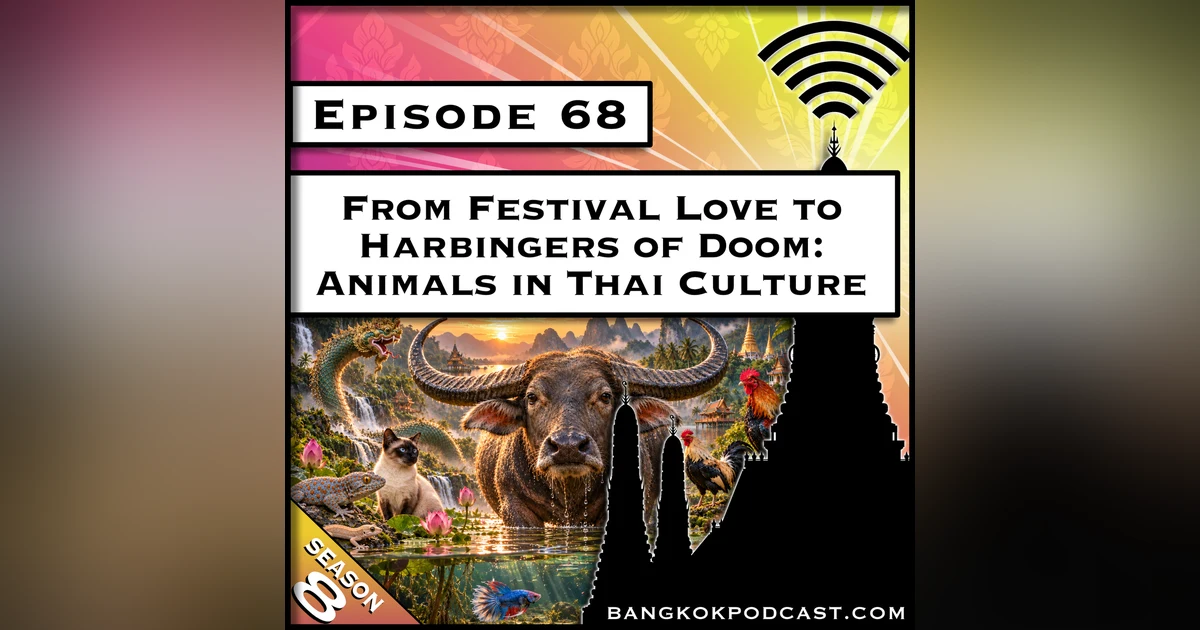
From Festival Love to Harbingers of Doom: Animals in Thai Culture [S8.E68]


 RSS Feed

 Spotify

 Apple Podcasts
Greg begins by explaining that a trip to the Chonburi Buffalo Festival got him thinking about the strange and special place animals hold in Thai culture, what with an entire festival built around an animal whose name is often used as an insult. The hosts agree to skip obvious examples like elephants and monkeys and dive right in with the water buffalo, once the engine of the rice economy. Ed points out an urban and rural divide, since the buffalo is revered in the countryside while Bangkokians use the word khwai as an insult. Comparisons to North American bison lead Greg into a tangent about Head-Smashed-In Buffalo Jump in Alberta. It's a real place, look it up.
Next, Greg turns to the house gecko, or jing jok, whose chirping as you leave home is taken as a warning, and Ed confirms his students still believe this. They then discuss the larger tokay, which appears in lullabies threatening restless children with having their livers eaten, prompting Ed to recall a girlfriend teasing her daughter that foreigners eat children's livers.
The hosts go on to fighting roosters and a legend linking them to King Naresuan, then the Siamese cat and the lucky black cat, and the Siamese fighting fish, which reached Western science as a gift from King Rama III. Ed then raises the water monitor, whose Thai name is a serious insult. Finally, Greg introduces mythical creatures, including the naga, a legged look-alike often confused with it, and the Garuda, Thailand's national emblem.
Ed 00:00:12 Ever wondered what it means if you hear a gecko chirping when you leave the house in the morning, you'll dig this episode of the Bangkok Podcast.
Greg 00:00:36 Sawa. And welcome to the Bangkok Podcast. My name is Greg, a Canadian who came to Bangkok in 2001 for a cheap root canal. But since I'm terrified of dentists, I'm still technically in the waiting room.
Ed 00:00:49 That does sound scary.
Greg 00:00:50 Yeah, the tooth is long gone.
Ed 00:00:52 And I met Ed, an American who came to Thailand on a one year teaching contract over 26 years ago, fell in love with showing off how good my Thai is when I meet tourists who just got off the plane, so I never left.
Greg 00:01:04 Because I like the thing of, like, fat people always hang around fatter people so they look skinny.
Ed 00:01:09 You know, when I, when I can say like, ha na pow! And then some guy who just got off the plane, he's like, oh my God.
Ed 00:01:17 Oh wow, you're Thai so amazing.
Greg 00:01:19 How long did it take you to learn Thai? How did they bring out a coconut? Because they heard Nam Pro instead of Nam pow.
Ed 00:01:26 All right, we want to give you a big thanks to all of our patrons who support the show. Patrons get every episode a day early behind the scenes photos of our interviews, a heads up to send questions to upcoming guests, and access to our discord server to chat with me, Greg, and other listeners around the world. But best of all, patrons also get an unscripted, uncensored bonus episode every week where we riff on current events and Bangkok topics. On this week's bonus show, we chatted about a cool road trip that our buddy Scott is doing in northern Thailand. Greg's visit to the Buffalo Festival in Chonburi, which includes the usual debate between me and him about the worthiness of Pattaya as a holiday destination, and discussions on Lisa's new music video called Tarantino and the Power of Pop Culture to learn how to become a patron and get all this good stuff, plus full access to over 800 bonus and regular back episodes.
Ed 00:02:24 Click the small button at the top of our website.
Greg 00:02:27 That's right. And as always, if you have a comment to show, idea or just want to say hi. Head to Bangkok podcast.com. Click the little microphone button on the bottom right. Leave us a voicemail and we'll play that on the show, just like you will find someone did at the end of the show. Right then on this episode, we are going to have a little bit of fun and a good ol chin wag about the animals that are sacred, or at least pretty important to Thai culture. Now, as we all know, this show exists to help us talk through our relationship with Bangkok and Thai culture on the way to hopefully understanding it a little bit more. And this past weekend, I found myself at another fun and unique tie festival that made me think about animals, specifically myself and our good buddy Scott went down to the Chonburi Buffalo Festival, which was pretty cool. We talk about that a lot on the bonus show this week.
Greg 00:03:11 And firstly, if you're unaware, the Thai word for buffalo is chi, which is often used as a pejorative for a dumb person, but at the same time, this is an extremely important animal in Thailand's agricultural past and present culture, so much so that they built an entire festival around celebrating the thing. We also have monkey festivals with elephant festivals. There's huge underground betting on cockfights. We have Disney movies about Siamese cats, primary school classrooms in the West have Siamese fighting fish, and those are just the animals that aren't mythical. So Thailand obviously has a special relationship with animals, and that's what we are going to talk about. So Ed, what what do you what's your take on this?
Ed 00:03:51 Well, I love this topic, partly because I feel fairly clueless about the deeper meanings behind some of these animals. We all know there's certain animals that Thai people love. Like the the the elephant is the iconic one. But I, I think it's more when it comes to elephants. it's just that Thai people kind of love elephants.
Ed 00:04:15 And frankly, I don't know what elephants stand for. I know that the white elephant, I think, was supposed to be very good luck for, Thai kings or Thai royalty.
Greg 00:04:24 Sure.
Ed 00:04:25 So what? What we want to do in the show is go a little bit deeper. Not not the super obvious thing. Like the elephant.
Greg 00:04:32 Yeah. Elephants and monkeys. We're going to stick away. Stay away from those because, you know, they're pretty obvious. They're all over the place and they're they're important. But there's a lot of sort of I don't know, I guess we call them secondary animals that are.
Ed 00:04:45 Well, these are more symbolic. Like these are, these are animals that, have some specific symbolic meaning. And if you're not Thai, you might not be able to guess what it is.
Greg 00:04:55 Yeah. Yeah. Right. And, you know, I've got some a couple of funny stories about some of these animals. but, let's start off with the one that that Scott and I saw down on the festival and the buffalo and and have you ever, ever had anyone call you a Cly?
Ed 00:05:11 no, I haven't, but I mean, this, you kind of made this point in the introduction.
Ed 00:05:16 it's a good example of the the kind of urban rural divide in Thai culture. You know, we've talked about, the two Thailand philosophy that, you know, there's Bangkok, right? And then there's the real Thailand outside of Bangkok. But I think you're right. Historically and traditionally, especially in the Thai countryside, the buffalo is revered. But for urban Thais. Hi. So Thais educated Thais, they use, they actually use the word buffalo as a pejorative.
Greg 00:05:45 That's an interesting take, though. Like, if, you know, if you call someone a kwai in Bangkok, they're like, how dare you? But if you throw someone a kwai out in San, they're like, oh, thanks very much. That's a noble, a noble beast.
Ed 00:05:57 I think that's roughly correct. I mean, we we need. We need any Thai people in our audience. But feel free to correct us if you if you jump on the discord server. But I think that's kind of true. I think I think for people outside of Bangkok, the buffalo is this image of like sturdiness and solidity.
Ed 00:06:14 And right again, there's all these festivals where where they celebrate the buffalo. But then it is used in a negative sense by by Bangkok ties.
Greg 00:06:24 Can you think of any Western festivals like where you grew up or me, myself, that are, that are centered around animals, that celebrate animals specifically?
Ed 00:06:32 And that's rough because, you know, I'm totally a suburban kid. I mean, for, for for good or bad. And, I know there's a I mean, I have friends in the US who I know have more of like a farming or agricultural background, but that's just totally outside of my world. Like, I just don't know anything about. But, I mean, animals play a huge role in, in all farming societies.
Greg 00:06:53 Well, sure, they play a role, but like, are there any festivals that celebrate the animal like or they.
Ed 00:06:58 There must be I'm sure throughout like you know for someone who teaches, American studies, I feel like I should know it. I'm sure there must be, but I.
Greg 00:07:05 Yeah, I can't think of any. The only thing I can think about is the Calgary Stampede. But that's more of, like, just a circus that has a rodeo. It's not about horses. Although they, of course, important to the settling of North America and stuff like that. But I thought about it before we started recording, and I can't think about any festivals that specifically are designed to, like, lift an animal up on a pedestal and go, yay, animal!
Ed 00:07:29 I don't know either, but I feel that, like people in rural areas, I feel like they must be doing that. But I'm I'm not part of that world, and I'm not part of, like, anything that's urban or chic. I have nothing to do with that. I don't do country. I don't do city, you know.
Greg 00:07:44 Yeah. Well, anyway, the Buffalo Festival was pretty cool, and I like Buffalo's. And I'll tell you, man, here in Bangkok, we're used to seeing them in a pen somewhere with a cement floor, like under a garage or the back of the temple or something like that.
Greg 00:07:56 It's a pretty sad existence, but man, I'll put some, you know, I'll put some pictures up on the website. But, we saw some buffalo down in Chonburi, this one, his name was Tong Lau and his head was the same height as my head. So that's 185cm.
Ed 00:08:13 Oh, shit. Wait, you have a picture, right?
Greg 00:08:15 Yeah. And this thing was just a solid wall of muscle and it was huge.
Ed 00:08:22 They are beasts, no doubt.
Greg 00:08:24 Yeah. So really important to, to Thai history in terms of, like, you know, agricultural stuff and what I've done for each of the animals we're going to, we're going to discuss here tonight. I also looked up a little bit online about how they connect to Thai folklore and culture and write history and stuff like that. So I got a couple of little bon mots about each one here. So how about the buffalo? it just says before tractors, the water buffalo was effectively the engine of the rice economy. It plowed fields, hauled loads and worked alongside farming families closely enough that it developed a surprisingly emotional cultural status, which I think is pretty accurate.
Greg 00:09:01 Yeah.
Ed 00:09:02 Yeah, well it's funny. you have, checked out these Buffalo festivals before, and I feel like it's, it it is kind of integrated into Thai culture. And in the US we're very aware of Buffalo's. You know, obviously we all know what buffalo's are. We know they were like a huge thing on the western plains.
Greg 00:09:21 You mean like bison?
Ed 00:09:22 Bison? Yes. Correct. Yeah. Bison. Bison is the correct word. but I remember when I first, when I was a lawyer, I took some time off and I drove across the US, from Chicago to California on the, in the West in the, I should say, the northern route. So I went through like, I went through, like South Dakota, Wyoming, Montana. And I got to see bison in the wild. And it was a little bit like the what you're talking about, where you're sitting in your car looking at them and they're they're immense. Yeah.
Greg 00:09:53 Yeah.
Ed 00:09:53 It's like they're, they're. Yeah.
Ed 00:09:55 Yeah. They're like big like a beast. I mean, they are like megafauna. Like old school. You know, they like they don't. You just don't see anything like them anywhere near the suburbs, you know?
Greg 00:10:07 Yeah. Yeah. What a soft city boy. No.
Ed 00:10:09 That's right. They are. I mean, I guess I don't want to. I don't want to be too strong, but they're kind of like majestic creatures. Yeah. so I, I get your point. So I'm. I'm looking forward to seeing your pictures.
Greg 00:10:23 Have you ever heard of a place called Head Smashed in Buffalo Jump? Bit of a tangent here, but.
Ed 00:10:28 No, I have not.
Greg 00:10:29 Okay, well, it's in southern Alberta or a bit north of Montana, but we visited on a school trip when I was in high school. It's a place called Head Smashed in Buffalo Jump, and it was a very important place in the in the First Nations and Native Americans because they used to sort of line up on this huge plane of grass out and like make like hundreds and hundreds of meters long chains of people.
Greg 00:10:51 And they all used to start running towards these herds of buffalo and push them towards the this cliff, and they would run off the cliff and die.
Ed 00:11:00 Oh, yeah. That's like a hunting method. Correct?
Greg 00:11:02 It's a hunting thing. Yeah. And then they would use the meat and stuff like that. But apparently there was a young, a young guy who was standing below where the buffalo came off one year and he got his head smashed in, so they got his head smashed in. Buffalo jump. That's literally the name.
Ed 00:11:16 Damn damn.
Greg 00:11:17 Buffaloes. So, the next one is something that everyone has seen, and I'm really surprised at the range of emotions that these elicit from people. but it's a little dink joke. The little. The little geckos.
Ed 00:11:31 Geckos? What we would call a gecko.
Greg 00:11:34 Do you find them cute or do you hate them?
Ed 00:11:36 No, they don't bother me. We've had this conversation before. I think they serve a purpose. I'm assuming they eat bugs and mosquitoes like I hate mosquitoes.
Ed 00:11:44 Yeah, so I'm guessing that they they they they they eat bugs.
Greg 00:11:49 Yeah, they do, and I think they're super cute. And when I catch them, I can. And I always hold them in my little, in my fingers and I little touch their little underneath their jaws and stuff like that. I'm sure they have fun, but they look cute. we've got a couple living in our house and we all, they're all called Bob. So whenever me, me or my wife or my son see it, we're like, hey, Bob.
Ed 00:12:07 And oh, that's funny.
Greg 00:12:08 Yeah. And, I think they're really neat. But man, some people, when they see them, they lose their minds. They just jump on chairs, they scream.
Ed 00:12:18 Yeah. Even, you know, even tie people, they, they for some time people, they function something like cockroaches.
Greg 00:12:25 Yeah. And they're not I mean, they're on opposite ends of the cute spectrum to a cockroach in my mind.
Ed 00:12:31 Of course.
Ed 00:12:32 Yeah. Of course. Yeah, I agree it was. I don't I don't know how you could group them together, but, listeners out there, the, the chink joke or gecko, as we would call it, it, it's essentially a symbol of bad luck. If you the idea is if you hear a chirping at you, like in the morning before you leave the house, It's meant to be a bad omen. Is that correct?
Greg 00:12:55 That's right. And that's the little piece of cultural folklore that I found out. And there's an old saying, I'm going to try and read it in Thai. Matching tongue fan, I don't know. I said that I'm trying to read Thai, but it basically translates to even when a lizard warns you, you should listen. And the underlying belief was that if a house gecko chirped just as you were leaving home, it might be warning you about your journey.
Ed 00:13:16 That's right. and, I, I've referenced this with my students and they all. This is definitely a real thing.
Ed 00:13:24 They all nod. It's not it's not some old piece of folklore that they're like, you know, that's like, oh, my grandma. Whatever. No, they're this is a real thing.
Greg 00:13:33 It's so funny how you bring that up. And they're like, oh, yeah, only an idiot doesn't believe that.
Ed 00:13:37 Right, right, right. Okay, okay.
Greg 00:13:40 You know what's interesting, too, about these Jing jokes? I've got a little red laser pointer here. And if you point that at the wall or the floor, whatever, they all chase after it. It's funny. They see it and they think it's a bug. And you can lead them on like these huge journeys across your wall. Pointing the laser at them.
Ed 00:13:55 Dude, I thought I thought you would know. Free time. Sounds like you got a lot of free time on your hands.
Greg 00:13:59 This is not free time. This is a serious hobby. but it doesn't work with green lasers. They can't see the green.
Ed 00:14:06 Oh, wow.
Ed 00:14:07 So you're. So you're saying you think they can only see the red pointer?
Greg 00:14:10 They do. They chase the red pointer every single time. But when I had a green one, they never even noticed it. So that's my conclusion.
Ed 00:14:17 Craig's scientific excursions.
Greg 00:14:19 Hey, you have a thesis, you test it and then you come up with.
Ed 00:14:23 There you go.
Greg 00:14:24 With a theory.
Ed 00:14:24 You're doing better than my students, most of most of them.
Greg 00:14:29 So, something that I, it took me a while to learn to the next animal was the difference between a joke and a joke. And, I used to call I see a big lizard. And I would say, oh, there's a Jing joke. And the Thais were like, that is not a joke.
Ed 00:14:45 Oh, I see, okay.
Greg 00:14:46 I made a faux pas. Do you know? You know what a joke is?
Ed 00:14:48 I do, I mean, I, I know it's bigger than a joke. That's about all I know.
Greg 00:14:53 Yeah, and I guess I guess in English we use the same word, the gecko or the house gecko.
Greg 00:14:57 But this one is like the garden gecko, and it's I don't.
Ed 00:14:59 Know, it is bigger. Yeah. It's bigger.
Greg 00:15:01 About 30cm long, about a foot long or so.
Ed 00:15:04 Yeah.
Greg 00:15:04 Yeah. And they are loud and, they look sort of prehistoric dinosaur like.
Ed 00:15:11 I feel that in English we use the word Tokay. Do we like Jingzhou? King joke is not King joke is not an English word. I feel like Tokay. Like. Let me. I'm gonna. I'm going to check it out right now.
Greg 00:15:22 I don't think I've ever heard an English word called a Tokay about the lizard. Of course, I am from Alberta, so we don't have them over there. We only have horses and cows.
Ed 00:15:31 so, I mean, Wikipedia just says the name of the entry is Tokay Gecko. Okay, so I guess obviously. So typically we use the word gecko, I guess.
Greg 00:15:41 Yeah. And they're a little bit frightening. They usually hang on the walls behind bushes outside and stuff like that.
Ed 00:15:46 Well, they can be very colorful, right? They have a lot of spots and stripes and stuff.
Greg 00:15:51 Yeah, yeah. I heard a joke the other day. I'm going to tell it here. so I was walking around in the forest the other day, and I saw a lizard, standing up, and he was telling jokes. Surprise me. Yeah. I was like, wow. So I came up to a villager, and I was like, hey, did you know that there's a lizard over here? He's like, telling jokes. And the guy said, that's not a lizard. That's a standup chameleon. So it's a dad joke.
Ed 00:16:18 Yeah. That is that is definitely in D&D territory.
Greg 00:16:20 So the interesting thing about a Tolkien, in terms of cultural folklore, this says there is a wonderfully sinister children's folklore surrounding them. Traditional lullabies in Thailand threaten restless children with a tokay coming down from the wall and eating their liver if they refuse to sleep.
Ed 00:16:36 You know, eating the eating the liver.
Ed 00:16:38 This is a thing I've heard before. so. Yeah. So the, Okay. It's funny, I didn't know this connection to the Tokay, the big gecko. But, I remember my early days in Thailand when I had a Thai girlfriend. She had a daughter. and, she told me that, I had to be, you know, when she introduced me to her daughter. It was a little bit awkward because her daughter, like that doesn't interact with frogs a lot. I'm like, you know, I'm like a new weird. A new weird thing in her life.
Greg 00:17:13 Mommy's weird new friend.
Ed 00:17:15 Yeah. That's right. And that's pretty quite accurate, actually. and, she was telling me that, Thai kids are scared of foreigners because, because people tell them scary stories that foreigners like to eat kids livers.
Greg 00:17:31 What?
Ed 00:17:32 This is a thing. I remember this. And, she taught me. She taught me the phrase like chop in top deck, which means I like to eat kids livers.
Greg 00:17:42 Fried chicken, top deck. yeah.
Ed 00:17:44 Yeah. She taught me the phrase, and she, like, she kind of taught me this, but she's like, don't say this to her daughter's name was, She's actually your wife's name? Same name as her daughter. She was like, don't. Don't say this to him. Like, she'll totally freak out. Like she thinks. She thinks foreigners like my. I can't remember where it came from, but she was like, yeah. My mom told her, like foreigners. Like the kids love her, so don't say this. So I would be teasing. I would always be teasing like, chop top deck. so yeah, there's something about it's so dark, like eating livers. It's like straight out. It's like Hannibal Lecter stuff, you know?
Greg 00:18:19 Yeah. No doubt there's fava beans down there, too. You're in trouble. I wonder if I could tell my son that and see what he says. So the next one is, of course, the cock.
Greg 00:18:31 I love seeing the cock.
Ed 00:18:32 Are you telling me Thai people worship cocks?
Greg 00:18:34 They worship the cock? they were talking about the fighting cocks, the fighting chickens and stuff like that.
Ed 00:18:39 I haven't followed this. I know, again, out in the countryside, in the villages, there are, cockfights. There must be illegal. I presume there must be technically a legal right.
Greg 00:18:51 probably. Yeah. I'm not sure if it's the the animal cruelty or the gambling that's illegal.
Ed 00:18:57 Yeah, probably both actually.
Greg 00:18:58 Yeah, but apparently these these have a long and illustrious history, royally connected in Thailand. And apparently it's got a there's I didn't have time to read it up and research a lot of it, but apparently there's a legend about, King Naresuan when he was held captive by the by the Burmese, that there was some chicken fighting going on or cock fighting, and his cock defeated the Burmese one. And it was sort of like a metaphor for, you know, the eventual battle or something like that. That's not a historical record.
Greg 00:19:26 It's just a legend. But, there's supposedly quite there's a certain type of, bird called the yellow white tail chicken, which is apparently, according to this, is called the King Naresuan Chicken. And it's, it's it's quite, illustrious.
Ed 00:19:44 And so certain types of chickens, have have symbolic value. Like a positive symbolic meaning.
Greg 00:19:53 Right, right. And it's supposed to be very powerful and strong and and proud and and there's a saying I found online that about if you have one of these chickens and you put it into a fight, the saying says, order your whiskey on credit, the chicken will win. So you don't even have to. You don't have to wait for the fight to be over because you know that you're if you're going to win.
Ed 00:20:13 Basically, if you have the right type of, of I feel funny saying cock, sorry. Yeah, I like rooster. I think typically we'd say rooster is that would that be the correct word?
Greg 00:20:24 I guess so, yeah. So the saying says that if you have the right one, you can say you can enter it into the fight.
Greg 00:20:29 Buy your whiskey on credit because you're guaranteed some income a little bit paying off. I like that.
Ed 00:20:34 Yeah. So this is something I, I feel like I've completely missed. I feel that, you know, it's it's tough because Western culture obviously is so deep. I'm sure in Western culture somewhere like roosters have this meaning. But like for whatever. It's a middle class American who grew up in the 80s and 90s. I don't like chickens. Are chickens.
Greg 00:20:54 Yeah.
Ed 00:20:54 You know, like chickens have no like, chickens have no special other than, like, they appear in cartoons, you know what I mean? It's like, right, like that Corn leghorn.
Greg 00:21:02 I'll say, yeah, I'll say, boy.
Ed 00:21:04 Yeah. What? I mean, like, so in my world, like, chickens have no special meaning.
Greg 00:21:09 Have you ever seen that that Thai whiskey called black cock?
Ed 00:21:13 I have seen that. Yes I have.
Greg 00:21:15 Buy some of that. Bring it home to my friends when I go back to Canada.
Greg 00:21:20 the next one is, Well, it's pretty not. Not too exciting, actually, but it's the Siamese cat.
Ed 00:21:26 Well, okay, I want to throw this out there before I saw this on your list, I want to say, since I've lived in Thailand, I don't think I've seen one Siamese cat. Agree? What we associate as a Siamese cat. I think it it is a quote unquote real thing. But in Thailand, it's pretty hard to find a Siamese cat. There's cats everywhere. There's cats all over the place.
Greg 00:21:48 They've got the weird tales with the right angle at the end.
Ed 00:21:50 I'm sure I've never. There's actually a black cat that lives right outside my home and sneaks in through my gate. and, you know, I'm not a superstitious person, so I don't care. But. Yeah. Have you. I, I can't remember ever seeing a Siamese cat in Siam.
Greg 00:22:10 No, I agree, I've never seen one like that. And my mom used to have one for years.
Greg 00:22:14 It was. She called it Sapphire. And it was a beautiful, like, white cat with gray around its face and really bright blue eyes. And it was a Siamese cat. it was the the stupidest, most skittish, violent cat ever. But it loved my mom and used to scream and scratch at everyone else. But, you remember that show? The what was it, lady in the tramp. And they had that song by the two Siamese cats that were like, really? You know, we are Siamese, if you please. I think it was. That's right. but, Yeah. And apparently you said something about a black cat coming into your house.
Ed 00:22:48 That's really good luck, right?
Greg 00:22:49 That's right. Yeah. And yeah, in the West, black cats crossing your path is, you know, it's a curse. It's bad luck. But this says here the Thailand historically had auspicious black cats. The conjure cat, described as completely black with striking eyes, was associated with prosperity and protection.
Greg 00:23:04 Nice. Bad luck.
Ed 00:23:06 Nice, nice.
Greg 00:23:06 There you go. There you go. And also, apparently, while looking this up, there's a rain ritual that they used to do in the villages. And, traditionally, villagers carried a cat through the community that was in a cage, and they would splash water on it, which must have really pissed it off. Its cries symbolically encouraged the heavens to produce rain.
Ed 00:23:26 Well, interesting.
Greg 00:23:27 Yeah. I mean, I just read that. I don't know if it's true. I've never seen that. But yeah. There you go. So these cats scored, bring them to Songkran, have some fun. And, the last one is the beta fish or the Siamese fighting fish. Did you ever have one of these when you were a kid?
Ed 00:23:42 I've never had it. I'm familiar with what it is. I've never been a fish guy. Did you have an aquarium? I'm not a.
Greg 00:23:47 Guy. My whole life, I had a big one growing up.
Greg 00:23:50 Oh, cool. And I used to take care of it. And I used to know all the fish, all the different names of all the different types of fish. And then we had one here in my condo for a while, and. Yeah. The Siamese fighting fishes. We always had one. And if we had more than one, we had to keep them separate because they would, of course, fight each other.
Ed 00:24:06 Now are they? Okay, so this is kind of like the Siamese cat. Are Siamese fighting fish actually popular in Thailand?
Greg 00:24:13 apparently, yeah. They live in, like, the shallow waters around rice fields and stuff like that. but.
Ed 00:24:19 To to Thai people collect them, like, are our Thai tropical fish people into Siamese fighting fish?
Greg 00:24:28 It says bait is naturally inhabit shallow freshwater environments, including rice paddies and slow moving waters. Thai breeders gradually selected them for aggression and eventually spectacular color and fin shapes.
Ed 00:24:39 Interesting.
Greg 00:24:40 Yeah. And the interesting factor that I found out about them was that, in, In 1840, King Rama the Third presented a fighting fish to a Danish physician named Theodore Cantor, and they later entered the Western scientific literature, and in 1909 the species received the scientific name betta splendens.
Ed 00:25:01 Oh, wild! I'm glad that it's actually a like a true real Thai thing. Yeah, sometimes, like a lot of a lot of labels, when you get into the history, you're like, yeah, that's totally not right. It's not from there. It doesn't, you know what I mean? You know, so in this case, the the label is correct.
Greg 00:25:16 And the name in Thai is black cat biting fish.
Ed 00:25:20 Oh. Black cat.
Greg 00:25:21 Okay. Black cat biting fish. So cool.
Ed 00:25:25 Hey, I want to throw this out there. these these are the animals we've covered, but the focus that we've had has been on, like, positive, like, auspicious things. But unfortunately, you know, we mentioned two types of lizards, like Jingzhou and Tokay, but, the water monitor unfortunately has a negative, a negative symbolic meaning.
Greg 00:25:49 Yeah. That's right. The. Yeah.
Ed 00:25:52 Yeah. Dude, you're not supposed to say that. Oh. I'm sorry. You don't have to say that out loud.
Ed 00:25:56 Sorry. So, yeah. So listeners out there, Greg just said a very, very bad word. Honestly, for Thai people, it's a it's a very nasty word. Their, their their word for water monitor. And again, I don't I don't want to even say a really nasty word in English. But if you imagine like some horribly bad word in English, like a serious insult word. the Thai word for water monitor, basically, is that word.
Greg 00:26:23 Yeah. If you if you call someone that out in a, like in a, in a social setting or something, you're liable to get punched in the face.
Ed 00:26:30 Yeah. This is not a, it's not a word to trifle with. And it's kind of sad. I've always been, I'm not super into it, but I have owned I've owned a snake. I've owned an iguana. I'm not, like, hardcore into it, but, like, I have no problem with lizards. I'm not one of those people. Right. And of course.
Ed 00:26:46 And of course, I like to take pictures of the water monitors in Lumpinee. Yeah. And it's funny because Tai people, if you're in Lumpinee, Thai people are kind of taking pictures of the water monitors, just like tourists are. So they're not they're not like running away from them.
Greg 00:27:05 Really? Yeah. But they they keep a healthy distance.
Ed 00:27:08 Yeah. But but symbolically, they, they look at water monitors like dirty creatures. They're it's funny. They I feel like they look at. They look at water monitors, like, kind of like we would look at, like, rats or like cockroaches. Like they think of monitors. Maybe because they're low to the ground and, you know, obviously whatever they're they're spooky kind of creatures. They just look at them as like, dark and low and and dirty, you know. Right. You know, and then but for most foreigners, we're just like, wow, that's so cool. So I got dinosaur, you know, and, you And so foreigners aren't running away, you know?
Greg 00:27:46 That's right.
Greg 00:27:46 Yeah. No, I've got some friends from out of town, actually. And we're going to Lapine Park on the weekend, so there's kids. There you go. You know, go check them out. They're cool for sure. so all those animals are real. But I wanted to quickly talk about some mythical animals, too. And, I just found this out actually doing doing some research for the show. And I don't have a lot to say about these ones, too, but, you know, the Naga. You know what the Naga is?
Ed 00:28:09 Sure, sure. The serpent like underwater serpent creature.
Greg 00:28:13 That's right. Yeah. And, another festival that is around the Naga, which is the fireball Festival in Nissan. But I don't think I'm ever going to go there because the photos and videos I've seen from it, just like hundreds of thousands of people, and you may or may not see a little, like, come out of the water or something like that.
Ed 00:28:30 Well, basically, it's like soldiers on the other side of the river shooting fireworks.
Ed 00:28:34 Yeah, basically, essentially what you're going to see probably.
Greg 00:28:37 But I didn't know this. But did you know that there are often two statues around temples and stuff, and we think it's a naga, but it's not. It's actually called a Hera or a Hera.
Ed 00:28:48 Nope. Don't know anything about it.
Greg 00:28:50 Yeah, it's another mythical serpent, but the Hera has legs like a dragon. Oh, okay. But it looks almost the same as a as a naga. But it's not there. Two very distinct mythical creatures.
Ed 00:29:02 Gotcha, gotcha.
Greg 00:29:04 and something another interesting thing I was reading about, I saw on Facebook, was that almost every culture in on Earth has a dragon myth. Myth?
Ed 00:29:12 Very cool. Maybe that means dragons were real back in the day.
Greg 00:29:16 Probably were. That's. That's what I'm taking away from it.
Ed 00:29:17 I think there's a theory that the reason Europeans believe in unicorns is that somebody saw a rhino in Africa. They came back to Europe and described what they saw.
Greg 00:29:30 Right. The telephone.
Ed 00:29:30 Guy. That's it. Yeah. That's it basically. Yeah. That's right. That's like a theory of unicorn. A theory of unicorns is that it's a telephone problem. Because why like why would. Because I think there's never been a horse with a horn, as far as I know. Like. I don't think they found. Actually, I don't know. I don't know shit about it, but, like, I'm not sure. Like, it's not like the unicorn is a creature from a million years ago.
Greg 00:29:53 Right, right, right.
Ed 00:29:55 Yeah, yeah. There's no like there's no reason to believe in in in unicorns. Unless someone saw a rhino and then went back and described it. And then someone told their friend. And then that leads to, like, the theory of unicorns.
Greg 00:30:09 There's a great tweet that I remember seeing. Actually, I just looked it up when you were talking about it says, how are unicorns fake? But giraffes are real. Like, what's more believable? A horse with a horn or a leopard? Moose? Camel with a 40 foot neck.
Ed 00:30:20 For real? Absolutely. Yeah.
Greg 00:30:23 And the last one is, of course, the Garuda.
Ed 00:30:27 Man, I love the Garuda. It's a cool creature figure symbol thing.
Greg 00:30:31 Yeah. And it's it's a it's the official government emblem. I guess it's a akin to the to the eagle on the American.
Ed 00:30:38 That's right.
Greg 00:30:38 Dollar or something like that. Or the moose or the beaver and the Canadian money. but yeah, it's a it's a cool sort of half man, half bird mythical creature. And of course, our good buddy Dan Frazer, has been in a movie called The Pack, which I think is another word for Garuda, but that came out about 20 years ago.
Ed 00:30:57 Yeah, only 20 years ago.
Greg 00:30:59 Yeah. And he got killed by the Garuda. Spoiler alert, but pretty, notable death. Anyway, interesting discussion about animals. Just a little bit of fun this week, but it. I'm surprised at how deep some of these go and how closely tied they are to folklore and mythology and bedtime stories and stuff like that.
Greg 00:31:18 I think more so than than what I'm familiar with growing up in the West.
Ed 00:31:23 Interesting. I think, you know, it depends on it depends on where you grew up and what your background is. You know, you know, if you're a Native American, you're going to have all all these symbols connected to different animals. But it's just once you hit the middle class, it's like you're just not connected to to nature, More or less.
Greg 00:31:41 Yeah, that's a good point. Yeah.
Ed 00:31:42 But our nature, our nature is, you know, McDonald's. That's our. That's our jungle.
Greg 00:31:47 Yeah. I didn't have a lot of agrarian pastimes when I was growing up.
Ed 00:31:50 Our jungle is the shopping center. That's our jungle.
Greg 00:31:54 Nice chat, nice chat. All right, we ask our listeners to send us a voicemail, like we said, using a little microphone button on our website if they have something to say. And this week we heard from our pal Justine. Take it away. Justine.
Justine 00:32:07 Hello guys, it's Justine here, your Sydney patron. I sometimes feel like I'm the only person listening to the Bangkok podcast who lives in Sydney. I can't possibly be true. Anyway, I finally thought of something to leave a voice message about. Which is this your conversation about Thai TV shows? I've been scouring Netflix for Thai TV shows since my last visit, and most of them are incredibly bad in all sorts of ways. But there are two that I've watched recently, which I think are really worth a watch and really gritty and interesting. One of those is The Mad Unicorn, which is about a guy who started this logistics business from an incredibly low base and became super rich, and how he does that and how he treats the people around him, which is good, and how he deals with the wealthy, high flow types trying to shut down his business. It's kind of fascinating, and I think it's based on a true story. So that's one wreck, and the other one is called Evil Lawyer, which I kept on thinking, oh, this can't possibly be something I'd want to watch.
Justine 00:33:19 It seemed way too dramatic when I saw the trailer, but of course I started watching it and got incredibly engrossed. It's not cheerful, it's not happy, but it shows a real underbelly of Thai life. And it shows all these people going to court, hoping for justice with very little likelihood of that happening. So it's kind of fascinating to me that these stories are allowed to be made without much interference from anybody, because they're not entirely flattering, but they're very real and they're well done. So that's my very long, recommendation for you. Keep up the good work, guys. I'm really enjoying the podcast, as ever, from Sydney.
Ed 00:34:04 Oh that's cool. I as I mentioned on the show, I had I had heard there were some good Thai shows on. So I got to get my act together. We got to check these out.
Greg 00:34:13 Yeah. I watched Mad Unicorn actually, just a few minutes of it just to check it out. I'd never heard of it, but it looks really good.
Greg 00:34:18 Like it's well shot. It's well produced. I, I will make an effort to check that out.
Ed 00:34:24 Awesome. Thank you. Justine.
Greg 00:34:25 Yeah. Justine, next time you're in town, you know, like we were talking about on the message, you go out for a year or something like that. She's Australian, so of course we're gonna do that. Cool.
Ed 00:34:34 All right. A final thanks to our patrons who support the show. Patrons get a ton of cool perks and the warm, fuzzy feeling, knowing that they're helping and are never ending. Quest for cool content. Find out more by clicking support on our website and connect with us online. We're Bangkok podcast on social media Bangkok podcast. Com on the web or simply Bangkok Podcast at gmail.com. We love hearing from our listeners and always reply to our messages. Unless of course, you're a PR agent who pitches clients who have no connection to Bangkok.
Greg 00:35:04 That's right. You can also find us on YouTube. Send us a voicemail through our website that will feature on the show.
Greg 00:35:09 Find me on blue Sky beacon K grey. Thank you for listening, everyone. See you back here next week for sure.