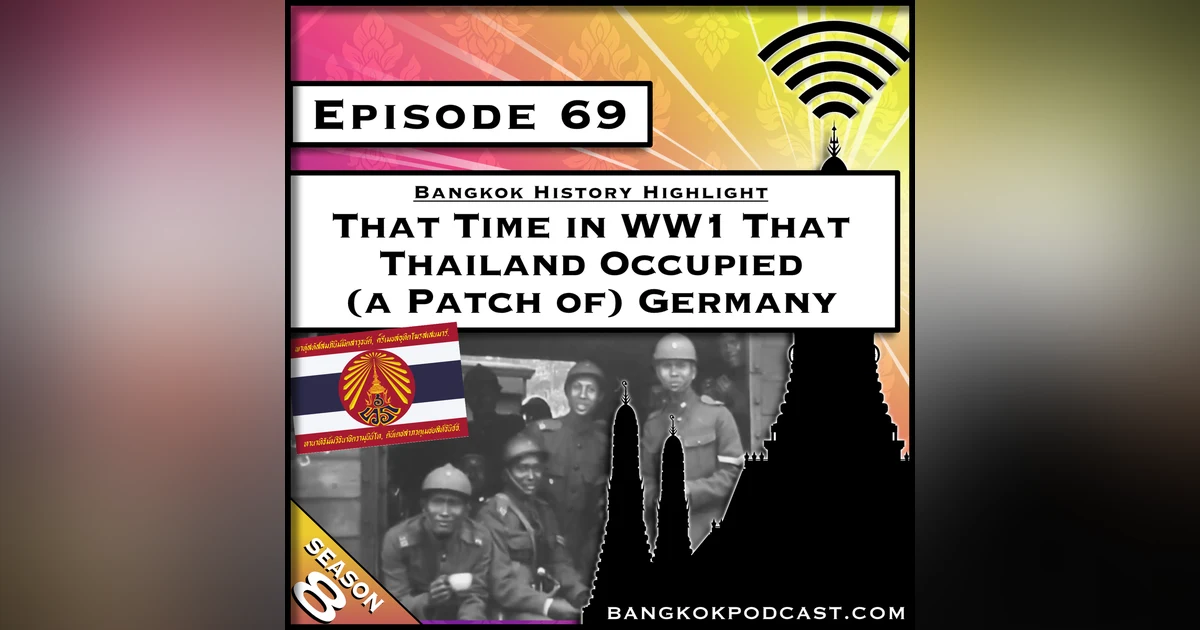
That Time in WW1 That Thailand Occupied a (Small Patch of) Germany [S8.E69]


 RSS Feed

 Spotify

 Apple Podcasts
Another fascinating history episode, this time looking into a little-known event in World War 1 that saw Thailand - er, Siam - occupying a small part of Germany!
Greg sets the stage by reviewing the assassination of Archduke Franz Ferdinand and the chain reaction of alliances that triggered the global conflict. Next, Ed brings up how this localized event snowballed into a world war and explains that Siam - typically pragmatic - initially remained neutral because it had close trade ties with Germany while being bordered by British and French empires. Ed notes that Siam eventually joined the Allied side to gain diplomatic leverage against unequal European treaties.
Greg then details the regional territorial losses and concessions Siam had suffered to France and Britain prior to declaring war on Germany and Austria-Hungary. After seizing German assets locally, Siam dispatched an expeditionary force to Europe to serve under French command. Although they earned a French award for bravery under artillery fire and lost soldiers to illness, they faced racism and marginalization from French officers. To ease these diplomatic tensions after the armistice, France assigned Siamese troops to temporarily occupy a small German town. Greg and Ed conclude the topic by reflecting on how this brief occupation allowed Siam to join the League of Nations.
See the photos below, including Thai aviators, photos from the war, the flag used by the expeditionary unit, and the memorial near Sanam Luang today.
Ed 00:00:11 So if you've ever wondered how Siam came to actually occupy a small patch of Germany, you'll love this episode of the Bangkok Podcast.
Greg 00:00:36 Sawa. And welcome to season eight of the Bangkok Podcast, episode 69. Nice. My name is Greg, a Canadian who came to Thailand in 2001 and quickly found out that the old fake shark fin taped to your back is not appreciated on Thai beach resorts.
Ed 00:00:53 That doesn't go over well. No. And why is episode 69 nice? Exactly.
Greg 00:00:58 I don't do a little bit of research. figure that out on your own.
Ed 00:01:01 And I'm Ed, an American who came to Thailand on a one year teaching contract over 26 years ago, fell in love with the Thai ability to nod knowingly when I say something cynical, but then to go on optimistically smiling anyway, so I never left.
Greg 00:01:17 It's like, here he goes again. Well, it's like crazy Uncle Ed.
Ed 00:01:21 Well, I think it's actually, I think it's more that it's more about just the Thai attitude towards things. So if I say something dark about Thai society, they never argue. They're like, yep, that's yeah, that's you're totally spot on. And then they just go on being happy and smiling. You know what I mean?
Greg 00:01:41 Like, oh no. Anyway.
Ed 00:01:43 Yeah you're right. You're totally right about that.
Greg 00:01:46 Anyway, eating yet?
Ed 00:01:48 Have you eaten yet? That's right. We want to give a big thanks to all of our patrons who support the show. Patrons get every episode a day early behind the scenes photos of our interviews, a heads up to send questions to upcoming guests and access to our discord server to chat with me, Greg and other listeners around the world. But best of all, patrons also get an unscripted, uncensored bonus episode every week where we riff on current events and Bangkok topics on this week's bonus show. We chatted about a story in The New York Times that discusses the very real belief that some Thai doctors have that eating KFC during a shift is a bad omen.
Ed 00:02:26 An update on my friend Steve's stroke recovery, and how Thai rehab facilities skate the line between comfortable and effective. A recounting by Greg of the very bad luck he had on a recent bike ride, and more debates on why Halloween is not more fully embraced by Thai culture. To learn how to become a patron and get all this good stuff, plus full access to over 800 bonus and regular pack episodes, click the support button at the top of our website.
Greg 00:02:54 That's right. And don't forget, if you listen to us on Spotify, you can now hear all the bonus shows there as well. If you're a patron, simply link your Patreon account to your Spotify account and add our new feed titled Bangkok Podcast Badass Patrons only to hear our regular and bonus shows there at the same time. And before we get into it, we have a quick update from the corrections department. Not really the corrections department, but it's sort of a listener edition. So if you remember our show we did last time about all of the animals in Thai culture and stuff.
Greg 00:03:21 Absolutely. And in that I said I can't really think of of many festivals in the West, at least where I'm from, that are built around animals that celebrate an animal like, you know, lots of festivals have animals, but I couldn't think of any that were held for animals. Right. But, one of our listeners, Bruce, wrote in and he wrote the following. He said, animal festivals in the USA. How about rodeos and state fairs where they have a pig judge and contest? Or how about the Westminster Kennel Club dog Show? There's a rattlesnake Festival in Sweetwater, Texas, sponsored by the Kiwanis Club, where they have a rattlesnake roundup and guess all things rattlesnake, including rattlesnake fried fritters. We have Groundhog Day in Punxsutawney Phil in Pennsylvania. Surely there are others.
Ed 00:04:08 Oh, Punxsutawney Phil, that's a good call.
Greg 00:04:10 I was like, damn. Yeah, every one of those is actually a festival built around an animal. Yeah, he's right, so I overlooked that completely.
Ed 00:04:16 But maybe maybe you and I, we grew up in it, and so we just don't see it.
Ed 00:04:21 We don't. We think of it as like, normal. And then we see this Ty stuff and we're like, oh, this is so cool. It's weird. It's different.
Greg 00:04:26 Right, right. At a ty is looking at like around a what a what comes up out of the ground. That's right. You base your ground logical readings for a.
Ed 00:04:33 Ground that was a groundhog.
Greg 00:04:34 A bunch of idiots. These superstitious morons. Yeah. So thanks, Bruce. You're right. we do have festivals built around animals like that. I don't know if there's, like, jovial and jolly and fun loving is having a miss Buffalo contest, but I. I guess probably they are. Yeah. Thanks, Bruce. On this episode we are going to jump back into our history highlight series with a really fun story that I had never heard before, and I have a sneaky suspicion that one of our patrons on discord told me about this, but I can't remember exactly where I heard it from. So if you did tell me about it, a thousand apologies for not remembering, but who you are.
Greg 00:05:14 But I did remember the story, and that's what we're going to get into tonight. So on this episode, we are going to be talking about the time that Siam actually occupied a small part of Germany in the final days of World War one. Now, we all know that Siam has never been colonized, but I never thought that they were going to be the colonizers. As it turns out, it's not as cut and dry as that, and there are a lot of nuance there that we'll get into. But the story is nonetheless a fascinating slice of history that I don't think many people know about. So let's dig in. So, editor, I'm a big fan of history, as you know. I think most of our listeners, though, I'm a huge fan of history, and I'm looking forward to digging into this one. you're a history. You're a pretty good history guy, too, right?
Ed 00:05:55 Oh. It depends. I teach an international relations class, so I know maybe the history of war, you know, starting with the Peloponnesian War.
Ed 00:06:03 But I do teach some stuff about World War one, World War Two in class. So I've got I've got the basics down. And I always knew somewhere along the line I heard that, Thailand or CM, sent some troops to help, the Western Alliance, in, in World War one, but I never knew the details. And then you just brought this up to me, the other day, and I did some research, so I'm down. Man, this is a crazy story. I didn't I didn't know most of these details.
Greg 00:06:33 Yeah, it's it's pretty neat. It's pretty neat. So let's set the stage about how World War One started. Having some background here is always good. So I typed this out and I'm going to read through it. But man it's one of the things that I've always struggled with my whole life, even as I sort of developed, I flowered, I blossomed into this fan of of history was exactly why World War One became so damn complicated, and I never really understood who was on whose side.
Greg 00:06:59 And I still kind of don't. But I gave it a sheen here. I gave it to sort of like a quick overview. And this is what happened. So in 1914, Archduke Franz Ferdinand, who was named after the band, he was heir to the throne of Austria-Hungary, and he was assassinated in Sarajevo by a 19 year old activist named Gavrilo Princip. Princip or Princip? I'm not sure how to say it properly, but when. True story. The driver of the Archduke's car who was visiting the city took a wrong turn and stopped right in front of Gavrilo to reverse and take the right term. Gavrilo had a gun and he pulled it out, assassinated the Archduke. So what happened next is crazy hard to follow. But basically Austria-Hungary then blamed Serbia for the assassination and backed by Germany, they declared war on them.
Ed 00:07:47 Yeah, the story is really even crazier. But it's for our purposes. We don't have to go into too much detail. So Gavrilo Princip was part of this, Serbian, more, I guess today we really call them terrorist group known as the Black Hand.
Ed 00:08:05 But, historically, there's a very serious question whether the Serbian government actually knew anything about this at all. So it's one of those things. It actually has parallels to things like al-Qaida, where where people today want to blame Saudi Arabia or blame a government where they claim, hey, we didn't know anything about this. So when Austria-Hungary had blamed Serbia, it was controversial because the government has always said, like, hey, we didn't know anything about these dudes.
Greg 00:08:30 Yeah. And for anyone interested, I urge you to read into the assassination attempt because it's.
Ed 00:08:34 The.
Greg 00:08:34 Story is crazy, right? Right. So, Archduke Ferdinand, he was shot. Austria-Hungary blamed Serbia for the assassination. And them and their buddy Germany declared war on Serbia. And then Russia came along and was like, hang on, Serbia's our buddy. So they joined the war against Austria-Hungary and Germany and Germany was like, nah. And they declared war on Russia as well as its ally, France. Then they decided to be a good idea to attack France.
Greg 00:09:07 And the only way to do that was going right through Belgium, which was neutral. So they thought what could go wrong? But of course, that brought the UK into the war. And trying to cut off the UK support for France. Germany started blowing up boats with its submarines all over the place, which pissed the US off and they were like, right, it's time to lay a beat down. And they declared war on Germany and Austria-Hungary. And that brings us right up to 1917. So is that kind of roughly what happens? What was the world like at that time? Had you sort of studied up on this geopolitical, geopolitical era?
Ed 00:09:43 Well, you're you're absolutely correct. World War One is, the beginning of World War One is just a famous mystery in the sense that the assassination, while obviously an assassination, is a serious thing. It was seen as kind of a local cultural. This really should have stayed in this kind of neighborhood. Right. But then one thing led to another one.
Ed 00:10:05 Domino fell. Like, as you kind of explained. And we end up with a world war. So it's a, it's it's it's a good example of how small conflict can lead to big conflicts. And this is why, I mean, it shows up today in the way people are worried about Ukraine, worried about Iran, because we've kind of learned this painful lesson that, hey, these local things, they don't always stay local.
Greg 00:10:28 Exactly right. Were there any countries that were not involved in World War One? Like I may imagine, like some little republic in the south tip of Africa wasn't, but.
Ed 00:10:36 Oh, sure. Like in, in World War One, World War Two, and even during the Cold War, there was even a coalition of countries just just called the non-aligned countries. And these were countries that were like, hey, we're out. Like, don't force us. You know, there's an award in wartime. People always want you to pick a side. So? So there's always been some countries who were like, hey, we're not doing that.
Ed 00:10:58 We're out like, we got other. We got our own. We got our own problems to worry about.
Greg 00:11:01 This sounds like a U problem. You know, it was out of this. That's right.
Ed 00:11:05 That's right. but to me, the fascinating thing is, Sam at the time was, caught between empires. So, as you said, Thailand was never colonized, but they had empires at their doorsteps. So they had both the British and the French at their doorsteps. Right. And, so at first you might think, oh, it would be natural for them to, to, to side with Britain, France and Russia. So the Triple Entente is, is Britain, France and Russia. Right. and so you might think it'd be natural for Sam to join that side, but, based on my research, I didn't really know this based on my research. Actually, Siam had pretty close Relationships with Germany. They rely they relied on some trade with Germany. And apparently Germany played a role in, some engineering in CRM.
Ed 00:11:58 They, they had like build some roads or something. And so initially the approach of the Thai government was to remain neutral. Yes. In other words, like we don't want to piss any of these European powers off, you know, we're, you know, Siam. And even today, Thailand is kind of a in IR. We would call them a middle power. Like, they're not they're not nothing. and they and they might play a role, in their own neighborhood in Southeast Asia. Thailand is, quote unquote, powerful. You know, compared compared to its neighbors. But when it has to rub shoulders with, great powers, European powers, it has to be very careful how it plays the game.
Greg 00:12:41 So they walk softly and they carry a bag of them.
Ed 00:12:43 That's right. Yeah. So I think that's the official. I think that's the name of the the name of the strategy. yes.
Greg 00:12:49 So it's almost Canadian in that, isn't it? It's sort of like there in the office on the sidelines going, hey, fellas, come on, can we all just get along?
Ed 00:12:55 That's right.
Greg 00:12:56 Know that we're all friends here.
Ed 00:12:57 That's exactly right. in general, Thailand has the history of really doing its best to remain neutral. And I think they do the same thing today with, Russia and Ukraine because they, they rely on trade with both countries. They have tourists from both countries. So they're just trying not to piss anyone off. Yeah.
Greg 00:13:14 I was talking about this with someone the other day, and I was explaining a little bit about World War Two, and I said how Thailand has always been very pragmatic about this kind of thing. It really sits back and it waits and it watches and observes. That's right. And then it makes a decision.
Ed 00:13:27 I mean, it can be frustrating if you really if you want them to, you know, like jump in and for a moral reason, like pick, pick the good guys. And but Thailand usually doesn't do that. They're, they're, they're, they're, they're, they're pretty focused on like realpolitik and self-interest. Well, it turns out that, the treaties that Siam had made with Britain and France in the 1800s.
Ed 00:13:50 Which opened up cm2. Trade. So you know when when when Thailand opened up to the west, it made a lot of money from trade. But the treaties that they signed were not really fair or equal. That's right. And so they and I so I think they, they benefited from these treaties for decades. But then by the early 1900s, they were looking for some type of leverage to get out of some of these. So it's one of those things where these treaties were a good deal for a while. But over time, Siam realized, okay, like these, these treaties are not really a good deal. So.
Greg 00:14:28 So exactly.
Ed 00:14:29 Yeah. So they were looking for a way to get some leverage, maybe with Britain and France. And so I think when Germany started getting more aggressive, attacking shipping, attacking American shipping, some of which was civilian, you know, so one of the issues in World War One is, is were the ships that Germany was attacking, were they civilian or military kind of thing? Right.
Ed 00:14:53 So, the Thai monarch, decided we are going to actually pick a side. So they, they have a they're very good at being neutral, but not always. And so they, they actually joined the war on the side of the Triple Entente and they declared war on Germany.
Greg 00:15:11 Right, right. Well that's really good though. So let's talk about the situation here for a little bit. So let's talk about what led to that, that decision. So up until that point, like you said, Thailand had been officially neutral in the war. This is up till 1917. And like you said, remember this time it was an absolute monarchy. This was before the coup in 1932. That's right. so so the king was in charge, and in recent years, around that time, Thailand had gotten somewhat of a black eye on the world stage, at least geopolitically speaking. So let's dig into that a little bit to give us some background. So in the 1860s, Siam had differing levels of authority and control over different parts of Cambodia, but this started bumping up against France's effort to expand its territory in Indochina and eventually Cambodia's King Norodom.
Greg 00:15:57 He agreed to allow the French to sort of apply their, quote unquote, protection over Cambodia and Siam, realizing it would be foolish to pick a fight with France, recognized France protectorate over most of Cambodia in 1867. In 1907, Siam ceded control over the portions it still did manage, which was Siam, Battambang, and Cisalpine, and it ceded those completely to the French. So Siam was now out of Cambodia, out of the Cambodia business, right? Okay. That was in 1907. backing up a little bit. In 1893, remember, they had the Paknam incident, where French gunboats sailed up the Chao Phraya River and blockaded Bangkok. And this, of course, I mean, there's a lot of details here that I'm skipping over. I'm just giving the basics. But all of this stuff, again, I urge people to look into all this stuff, because each one of these points is just a crazy, fascinating story. So when the French blockaded Bangkok, this, of course, put a lot of pressure on British interests in Siam at the time as well.
Greg 00:16:56 And then the Brits put pressure on the French and the Siamese to come to some sort of an agreement. As this was happening, Siam was also fighting the French in Laos at the Franco Siamese war. And after all of this was put into the washing machine and all of it came out in the wash. When all is said and done, Siam agreed to also cede most of Laos also to the French. So beginning of the 20th century, they had just given up a lot of territory.
Ed 00:17:25 That's right. Correct.
Greg 00:17:27 So in addition to this, the UK had forced Siam to give its citizens extraterritorial rights when the Bowring Treaty was signed in 1885. Just kind of a kick in the nuts, actually, for a sovereign country for someone to step in and say, by the way, are people in your country. You can't charge them with any crimes. It's sort of a diplomatic immunity thing.
Ed 00:17:47 Well that's right. I mean, this was just a question of the obviously European powers were just more developed. Yeah.
Ed 00:17:54 The the Thai kings, to their credit, were trying to modernize Siam, but, they didn't have much leverage. I mean, they had certain products like rice and other things that the Western powers wanted to trade for. But those early deals were slanted, you know. And then by, you know, by the time we're talking about, by 1917, Thailand was looking for a way to, to get a seat at the table. And so I think by choosing a side and, you know, and, putting, putting their own skin in the game, they're trying to get some leverage, to renegotiate some of these deals.
Greg 00:18:32 Right, right, right. And in 1909, Britain, they wanted greater control of the Malay Peninsula, which was one of their colonial areas of interest. So they, they sort of kind of made Siam an offer it couldn't refuse for the provinces of Kedah, Kelantan, Perlis and Terengganu in Malaysia. But in that process at least, Siam negotiated an end to the extraterritorial rights for British expats as part of the deal because Siamese justice system had developed since that was the Bowring Treaty came into effect.
Greg 00:19:02 Right? So they sort of had a bit more standing and they could say, okay, yeah, you can have this, but we want this. And Britain agreed to it. So all of that being said, Siam was kind of like I said, had a bit of a black eye here. Geopolitically speaking. There had been a rough couple of decades. They'd lost a lot of territory. They had these superpowers sort of monkeying around in their internal affairs, and they were looking for a way to sort of plant their flag, so to speak, and to, to strengthen their standing as a sovereign nation, as you said. And, it declared war on Germany and Austria-Hungary on July 22nd, 1917, officially entering World War One.
Ed 00:19:40 They picked a side.
Greg 00:19:41 They picked a side. They sure did. Yeah. and at the time, actually, the Siamese government even seized German owned businesses, property and financial assets in Thailand. they closed shops and restaurants. detained German and Austro-Hungarian citizens and actually seized nine German merchant vessels that were docked in the Chhapra River.
Ed 00:20:00 Interesting man, I wish I, I knew more about this. I mean, this is a good, intro. I wonder how many, like, how many Germans could there have been in in Thailand? In Siam in 1917? So, I mean, they actually detained German people. So I wish I wish I knew more about that.
Greg 00:20:16 there's probably a number of them. I mean, early 20th century Bangkok was developing very rapidly and was about to start developing very rapidly.
Ed 00:20:23 And, well, they were the, like trade was exploding. So there were a lot of foreigners here, I think.
Greg 00:20:28 Yeah, I remember I mean, Holland Station was built in 1916, so there was all these European architects and artists and designers and engineers in Thailand. So, you know, probably a lot of them.
Ed 00:20:41 Sure. For sure.
Greg 00:20:42 Yeah. So, they decided to enter World War One. And at the beginning of 1918, Siam sent almost 1300 troops to Europe to support the war effort. And it was the only expeditionary force fielded by an independent Southeast Asian country.
Ed 00:20:58 It's funny, I gotta I gotta interject this thing. Way back in the day, 20 years ago, I was talking to a Thai woman, and somehow we were talking about this. But I just knew a little bit like, I knew that Thailand had sent some troops. And I remember having this conversation and she didn't know much about it. And I said something like, wait, how did how how did Thailand get troops to to Europe? And I remember she's sitting there. She's like, maybe they maybe they marched and I and and I remember going, oh, wait, that can't be. No you can't, you can't, you can't march your way across the continent. And so she didn't know. And so obviously they, they must've like put him on a steam ship and like, like made their way all the way to all the way to France, right?
Greg 00:21:49 I guess so it's not like they put him on a 747, right?
Ed 00:21:51 I mean, that's a long I mean, that's a pretty damn long journey, right?
Greg 00:21:54 They had very primitive aircraft back then.
Ed 00:21:57 There's no way they flew. It's 1917. They didn't get on a plane. They must have gotten on a ship. How long is that, like a six month journey?
Greg 00:22:06 I don't know, they don't have steamship on Google Maps anymore. They only have rail. But remember that from 1913 to 1914, the Royal Bangkok Sports Club was actually Bangkok, Thailand's first airfield. Airport.
Ed 00:22:18 I don't think they flew. There's no way they flew 1300 troops. It must. It must have been by boat. But I mean.
Greg 00:22:24 It would. It would have. It would have taken 800 trips on an airplane to get them in there and their bags there. I don't know, I'm just saying they had airplanes, but yeah, they weren't ferrying troops back and forth.
Ed 00:22:32 I don't know anything. It's funny. I feel like I should know this, like, was the Suez Canal operational? Like. So I'm not sure. Did they go like around Africa?
Greg 00:22:41 Again, another another great data point to dig into and look up a great story.
Ed 00:22:45 Yeah. But somehow maybe maybe they transported like on Star Trek. Maybe they had a transporter.
Greg 00:22:51 Yeah, that's that's what happened. You don't have airplanes, but we can just beam you over. So when the Siamese troops arrived in Europe, it was agreed that they would work under the umbrella of the French forces. But tensions soon developed as racism and language barriers caused all kinds of misunderstanding and crossed wires. Now, by this time, the war was nearing its end, and although Germany and France were still fighting, Germany was starting to be pushed back. And from 26 to 30 1st October 1918, Siamese motor transport troops delivered supplies to French soldiers in an area under German artillery bombardment, and actually their courage in this role earned them the France's Croix de guerre award. I have no idea if I'm saying that right. Probably I'm not. But they saw they saw action, they were bombarded with artillery and they were rewarded for it. So that's definitely.
Ed 00:23:42 Crazy. So you know, so they obviously they showed up.
Ed 00:23:46 Apparently they showed up towards the end of the war, but they actually did catch some serious action.
Greg 00:23:51 They did. Yes, yes. And I have this later on in the notes. But I can say it now like actually no, no Siamese troops died in this, in this exercise, in this whole experience, from from military action. But about 19 of them died, half of them approximately from the Spanish flu and half of them from other diseases like pneumonia and things like that, that they caught while battling the cold during the winter because they weren't used to. Yeah. And actually, if you go to the northwest corner of Saddam Luang, you know, the big open field, north of the Grand Palace, you can see a memorial to these 19 soldiers, and their ashes are actually interred at the memorial. So I've ridden by it on my bike a million times and driven by it in cars a million times, but I've never actually gone to check it out, so I'll have to stop by next time I'm in the area.
Greg 00:24:37 So, French officers were constantly, bypassing Siamese commanders while Siamese personnel felt sidelined and treated more like colonial troops than representatives of a sovereign nation who was a legitimate ally in the war effort. And I was reading one incident that talked about how Siamese aviators were saying, please let us join the front line French squadron. We can fly. Airplanes were trained by Belgian and French pilots, but they were just sort of to told like, let's just sit down and let the adults take, take, take over here.
Ed 00:25:08 Oh, brutal. That's right.
Greg 00:25:10 Yeah. So understandably, after a while, Siam considered very seriously, just completely withdrawing the expedition entirely and pulling their troops back out of the war effort. And this is where things changed a little bit. And what led to our whole, main, main thesis of the show. But like we said, the war was winding down. And at the Armistice of Compiegne on November 11th, 1918, the allies occupied designated German areas. Now, France was put in charge of this area called the Palatinate.
Greg 00:25:39 Palatinate? I'm not sure how I'm saying that. Right. Maybe it's Paladino. I'm not sure. and tensions were still very high, though, between between the Siamese and the French. And the Siamese were pissed off that they weren't getting the proper thing. They came all this way, and they weren't allowed to do anything, or that they wanted to do. And so, as sort of a diplomatic salve, the French military decided to give Siamese troops an occupation assignment to sort of let some steam out of the diplomatic tensions that have been building.
Ed 00:26:08 I love that, I love this like, this is such a cool, unique little like corner of history that I just never knew anything about.
Greg 00:26:16 It's such a diplomatic solution to like, this is such a backroom dealing with all these bureaucrats and diplomats.
Ed 00:26:21 I feel like I feel like there's a there's a movie in here. Like, can you imagine, just like young Thai guys in Europe in the middle of a crazy war they know nothing about? Like they got French people over here or being annoying and superior, and then they're getting bombed.
Ed 00:26:35 And then. And then they get assigned to occupy a German town.
Greg 00:26:39 Right, right. Is that right? So? So, about 200 Siamese troops, served in an area around Neustadt an der Weinstrasse, including nearby communities, from December 1918 to July 1919.
Ed 00:26:55 Okay.
Greg 00:26:55 Yeah. So they basically said, okay, that little part over there, you guys go and control that part. You take care of that part. You're.
Ed 00:27:02 This is wild. This is why.
Greg 00:27:03 You're in charge over there. they exercised temporary military authority under the Allied occupation arrangements. Although, we have to say they did not technically annex or acquire sovereignty over any German land.
Ed 00:27:15 Now, that would that would be too crazy. That would be so. So they weren't actually colonists?
Greg 00:27:21 No, no, no, they were not. But they certainly were in charge of a big chunk of.
Ed 00:27:25 They were occupiers. They were they were temporary occupiers of some relatively small section of Germany.
Greg 00:27:32 Yeah, I guess so.
Ed 00:27:33 Yeah.
Greg 00:27:34 So this was until July 1919.
Greg 00:27:36 But of course, the Treaty of Versailles, which officially brought the end of World War One, that was signed on June 28th, 1919. So a few weeks before they officially left, the Siamese contingent then handed occupation duties back to the French. In July, they took part in Allied victory celebrations and returned home. France continued its occupation afterwards, and the treaty entered into force on January 10th, 1920. And for their efforts, Siam was actually one of the original signatories to the League of Nations, which of course led directly into the United Nations.
Ed 00:28:08 Yeah. For sure. You know this, like I said, I didn't know the details of this incident, but what I'm learning from your research fits with a few things that I do know. And, these these early interactions with, Europeans. It's a little bit depressing because the the Thais were trying to show. Hey, we're ready to sit at this table, right? We want to. We want to be modern. We want to be. Quote unquote, civilized.
Ed 00:28:39 But in the end, they felt kind of treated pretty poorly. And they came away from these interactions thinking that the Europeans were pretty racist. You know, this is in this is in Thai writing where they where they felt like, hey, we did our part, we did what we're supposed to do, but we were kind of treated like second class citizens.
Greg 00:28:58 And rightly so. They weren't given their due. I think they were probably quite talented and brave.
Ed 00:29:03 Yeah. So it is a, a little, a little bit depressing, but you got to give a plucky Sam their credit like they, they stepped up.
Greg 00:29:10 Totally, totally. And so yeah, that was basically the end of it. they saw a little bit of action, but they weren't involved in really heavy fighting. They weren't there for many years or anything like that, but they were definitely there and they had an effect. There's actually a quote from King Rama the Sixth. And when all this was said and done, he said it was the proudest day in my life when I learned from my troops had advanced into enemy territory, and the memory of this glorious event will ever live in mind as an incentive to further sacrifice on behalf of my beloved nation and motherland.
Ed 00:29:40 Oh that's great. That's a great quote.
Greg 00:29:41 Yeah, yeah, it was pretty cool. So what a crazy story. I had never heard of this before, and it doesn't have any. Yeah. You know, it didn't change the course of history or anything like that, but it sure is a neat story.
Ed 00:29:52 Right? But if someone if someone had asked me, you know, and as I say in the intro, I've been here 26 years, if someone had asked me yesterday, you know, did Thailand occupy a part of Germany in World War One, I would have said, no.
Greg 00:30:09 No. What? Are you, crazy?
Ed 00:30:09 Don't do that. Yeah. Are you a crazy person? That's right. So, I mean, it apparently was not a very big part of Germany, and it wasn't for like that long. But, technically, the answer is yes.
Greg 00:30:21 Well, they did. If you if you go online and you look at this on Wikipedia, which I, which I urge everyone to do, and we'll include this photo in our Patreon Emails as well.
Greg 00:30:33 there's a map of the occupied parts of Germany and the, you know, it's done with, like, the flag of each country, which is occupying the territory. So, so the part of part of Germany where this whole incident took place in is in sort of like the western part of Germany, up near Luxembourg and Belgium, and some provinces over there. And so this map, you see where this area, how it was divided up. So you see the Belgian map and you see the UK map and the US map, and the French map is huge. But way down in the corner, in the bottom right part of the French zone is a little tiny circle. And in the middle of the circle is a white elephant and a Thai flag.
Ed 00:31:08 Oh. That's awesome. Awesome. Yeah. Love it. Yeah. Love it.
Greg 00:31:12 So, there we go. Great story. And, cool part of history.
Ed 00:31:16 No doubt, no doubt about it. Love it. Yeah. Cool.
Greg 00:31:19 All right, let's get into some love, loathe or live with where one of us picks a particular aspect of living in Bangkok, which we discussed to decide if it's something we love about living here, loathe about living here, or have come to accept as something that we just have to learn to live with no matter how we feel about it.
Greg 00:31:30 And this week, editor I'm throwing it over to you. What do you got?
Ed 00:31:33 Dude very direct, simple question. I know you're not a huge drinker, but you're you're a mild occasional embalmer.
Greg 00:31:41 I do have my favorites.
Ed 00:31:42 You. what is your take on what people call high whiskey, even though it's actually, I think it's technically a rum. What is your take on saying some.
Greg 00:31:53 Love it hard love. Hard love.
Ed 00:31:55 Oh, interesting. This is. Well, here's my take. it. Okay. Certain, whiskeys or rums? I kind of like the flavor of. I don't really like the flavor of saying so, but throw it in, like, give it a mixer. It's fine.
Greg 00:32:10 Oh, yeah. I wouldn't swing it from the bottle. Yeah, but you.
Ed 00:32:13 Wouldn't pick it from the bottle.
Greg 00:32:15 Mix it with with some Coke. Oh, yeah. I could drink all night.
Ed 00:32:19 And it's super cheap. Okay, interesting. So I'm not sure I'd say I'm a hard love, but.
Ed 00:32:23 Yeah, I mean you. Because some foreigners give saying some a bad rap. They're like, oh, that's like yeah, I'm not going to drink that swill. I'm not going to drink that stuff.
Greg 00:32:31 No, no, I prefer Jack Daniels. That's that's my favorite. But, you know, I'm sure I've told this story before, but when my, about six months before I came to Thailand for the first time, one of my good friends from Canada visited first. And he brought back a bottle of saying some.
Ed 00:32:46 Oh that's right. I vaguely remember this. Yeah, yeah, yeah.
Greg 00:32:48 I mean, he's like, check this out. This is like Thai whiskey. And we were like, ooh, we poured some out and we tasted it and we were like, wow. Like, this is five star gourmet stuff. Amazing. Like, we were just blown away. And he didn't tell us he could get it for $0.99 at the 7-Eleven. Right.
Ed 00:33:04 But that's funny, you know?
Greg 00:33:06 So I like it, I like it.
Ed 00:33:07 I, you know, again, I don't really like his flavor, but it just seems to mix. Well.
Greg 00:33:13 yes. Yes, I agree with you. Hard, hard love on that one.
Ed 00:33:16 A dual, a dual love. There you go. All right. A final thanks to our patrons who support the show. Patrons get a ton of cool perks and the warm, fuzzy feeling knowing that they're helping in our never ending quest for cool content. Find out more by clicking support on our website and connect with us online. We're Bangkok podcast on social media Bangkok podcast. Com on the web or simply Bangkok Podcast at. We'd love hearing from our listeners and always reply to our messages. Unless, of course, you're a PR agent who pitches clients who have no connection to Bangkok.
Greg 00:33:54 That's right. You can also listen to each episode on YouTube. You can send us a voicemail through our website that we'll feature on the show. Hit me up on blue Sky on BCC. Greg, thank you for listening, everyone, and I'll see you back here next week, no doubt.